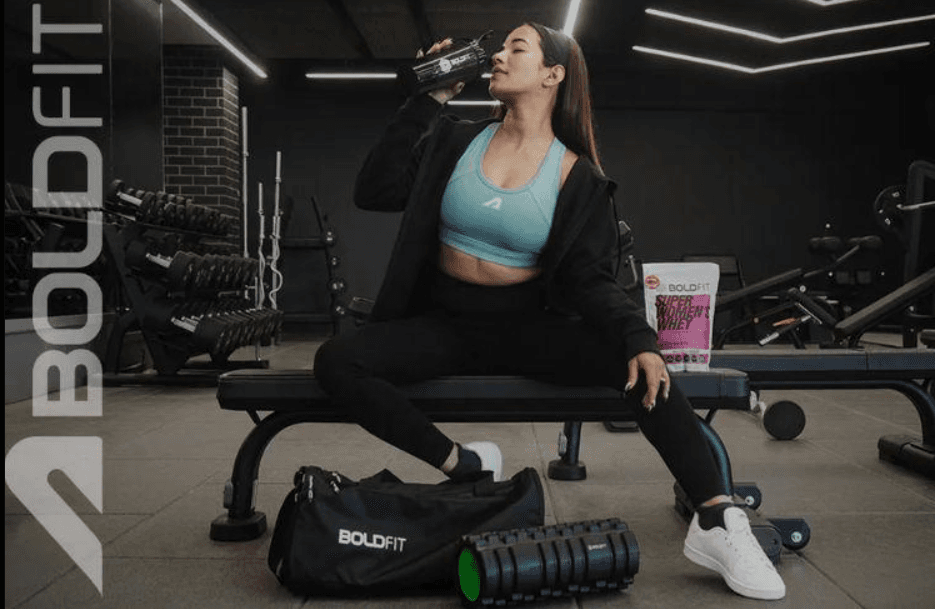
Boldfit’s ₹400 crore Series B is not simply a growth-capital round. It is a strategic admission that an online-first fitness brand cannot build a durable consumer business on digital marketing, third-party manufacturing and marketplace distribution alone.
The Bengaluru-based company will use the capital to expand physical retail, scale manufacturing, accelerate product innovation and pursue selective acquisitions. Founded in 2018, Boldfit sells performance sportswear, athletic footwear, sports equipment and fitness essentials, and says it serves more than 2 crore customers annually. The Economic Times reported the funding plan; Entrepreneur India and Apparel Resources also reported the round.
The real question is whether Boldfit is buying control over margin and supply—or merely converting a variable-cost business into a fixed-cost one.
The D2C model is changing
For much of the last decade, Indian consumer brands were built around an asset-light D2C playbook: outsource production, sell through marketplaces and own websites, acquire customers through performance marketing, and avoid the capital intensity of stores and factories.
That model helped brands launch quickly. But it also created a structural problem: the brand owned the customer relationship, while suppliers, logistics providers, marketplaces and advertising platforms controlled much of the cost base.
Boldfit is moving away from that model. Its stated plan—retail expansion, manufacturing, product development and acquisitions—suggests it wants to own more of the value chain rather than remain a marketing-led reseller. Moneycontrol reported that the company plans to use the capital for retail, manufacturing and product development; Business Standard similarly framed the investment as a bet on India’s fitness boom.
This is not unique to Boldfit. It reflects a broader correction in Indian consumer brands: D2C is no longer a business model. It is a distribution channel.
Why online fitness economics are difficult
Online fitness retail looks attractive because it gives a young brand national reach without an initial store network. But the economics are less forgiving than they appear.
A typical online sale carries several costs that do not show up in the headline product price:
- Customer-acquisition spend on Meta, Google, influencers and marketplace advertising.
- Marketplace commissions, payment costs and platform fees.
- Warehousing, pick-pack, shipping and returns.
- Discounting during sale events and promotional cycles.
- Product returns, especially in apparel and footwear.
- Working capital tied up in inventory.
For fitness gear, the problem is sharper because many products are bulky, low-frequency purchases. A yoga mat, dumbbell set, resistance band or treadmill accessory may not generate the repeat purchase frequency of personal care or food. That makes customer-acquisition cost harder to amortise.
Boldfit says it has grown at more than 80% annually over the past three years, but sustained growth must eventually be tested against unit economics, inventory turnover and cash conversion. Moneycontrol
What manufacturing actually buys
Boldfit’s decision to invest in manufacturing is the most important part of the story.

Manufacturing can give a consumer brand four advantages:
- Cost control: Direct control over inputs, production runs and wastage can reduce dependence on supplier margins.
- Speed: The company can test designs, colours, sizes and product variants without waiting for a third-party supplier’s production calendar.
- Quality: Owning production makes it easier to enforce specifications, especially in footwear, apparel and equipment where quality failures damage trust.
- Supply resilience: Domestic capacity reduces exposure to import duties, shipping delays and currency movements.
But manufacturing does not automatically create margin. It creates a new set of risks.
A factory needs capital expenditure, skilled labour, quality control, procurement systems, inventory buffers and consistent utilisation. If Boldfit builds capacity ahead of demand, it may simply replace supplier risk with underutilised-asset risk.
The company’s stated use of proceeds includes scaling manufacturing, but the disclosures do not yet establish how much capacity it will build, where it will be located, or how quickly it expects utilisation to rise. The Economic Times
The gross-margin equation
Boldfit’s expansion should be judged through one question: does owning more of the chain improve gross margin after all costs?
| Value-chain layer | Potential benefit | Hidden cost or risk |
| Online D2C | Direct customer data, full-price control | High acquisition cost, returns, logistics |
| Marketplaces | Reach and discovery | Commissions, discounting, limited customer ownership |
| Offline retail | Higher trust, trial, larger basket size | Rent, staff, inventory, slower cash cycle |
| In-house manufacturing | Lower input cost, faster iteration | Capex, utilisation, quality control, working capital |
| Acquisitions | Category entry and capability | Integration risk, valuation risk, management bandwidth |
The company’s opportunity is to use manufacturing to reduce product cost, retail to reduce reliance on paid acquisition, and acquisitions to add categories or capabilities. But each move consumes capital and management attention. A more integrated model can be superior—but only if Boldfit can operate it well.
Why retail matters more than it looks
Boldfit’s retail expansion is not just about adding stores. It is about changing the nature of demand.
Fitness products often benefit from physical trial. A consumer may want to test shoe fit, feel the quality of activewear, inspect equipment or receive advice before buying. Online product pages cannot fully solve that problem.
Physical retail also allows a brand to build a more complete sporting ecosystem. A customer who enters for a yoga mat may leave with resistance bands, apparel, footwear or a fitness accessory. That increases average order value and reduces dependence on a single product category.
Boldfit’s earlier ₹110 crore raise from Bessemer Venture Partners in 2024 already signalled an offline push, with plans to open physical stores over the following 12 to 18 months. Indian Retailer reported that earlier funding context. The latest round suggests that the company now sees offline as central, not experimental. Sports Economic Times described the latest funding as a push beyond digital-first fitness retail.
The fitness market is growing, but it is fragmented
Boldfit’s bet is that fitness is moving from a niche, metro-led interest to a mainstream active-lifestyle category.
The market evidence supports the direction, though not without caveats. India’s gym-equipment market was estimated at $681 million in 2025 and $760.2 million in 2026, with projected growth to $1.39 billion by 2034, implying a 7.85% CAGR. IMARC Group provides that estimate.
A broader India sports-gear estimate puts the market at $851.7 million in 2025 and projects $2.05 billion by 2035, implying a 9.2% CAGR. Emergen Research provides that projection.
These estimates should be treated as directional rather than precise. Definitions differ across reports, and “fitness” includes everything from low-ticket accessories to commercial gym equipment. But they point to a market that is expanding steadily rather than explosively.
The competition is not just D2C
Boldfit is entering a market where the most formidable competitor is not another D2C brand. It is Decathlon.
Decathlon combines scale, private-label manufacturing, physical retail, value pricing and a broad product assortment. It operated 132 stores across 55 Indian cities and had 113 manufacturing sites and 83 suppliers in its India production ecosystem, according to company disclosures cited in industry reporting. Emergen Research
That creates a difficult benchmark. Decathlon can offer breadth, affordability and physical availability at scale. Boldfit must therefore avoid competing purely on price. Its advantage, if it has one, must come from India-specific product design, faster innovation, stronger digital engagement and a more focused brand identity.
Other established players—including Nivia, Cosco, SG and Yonex—already have recognition in sports equipment. Global brands such as Technogym, Life Fitness and Johnson Health Tech compete in the premium and commercial-equipment segment. Emergen Research and IndexBox cover the competitive landscape.
Boldfit’s challenge is therefore not to become India’s Decathlon overnight. It is to build a defensible position in selected categories before expanding into a broad sports portfolio.
The verdict
Boldfit is making a reasonable bet: India’s fitness and active-lifestyle market is expanding, consumers are becoming more willing to buy branded sporting products, and an integrated model can create advantages that pure D2C cannot.
But the company is also taking on the hardest version of the consumer-brand problem. It is no longer simply trying to acquire customers online. It is trying to build products, manufacture them, distribute them through stores and integrate acquisitions—while maintaining growth and margins.
If Boldfit can convert manufacturing into lower landed cost, retail into productive distribution and acquisitions into genuine capability, it could become one of India’s more serious homegrown sports brands. If it cannot, it may discover that owning factories and stores does not create margin—it only makes the losses more visible.
Read More: Why Big FMCG Is Shopping for Small Ice-Cream, Snack and Beauty Brands