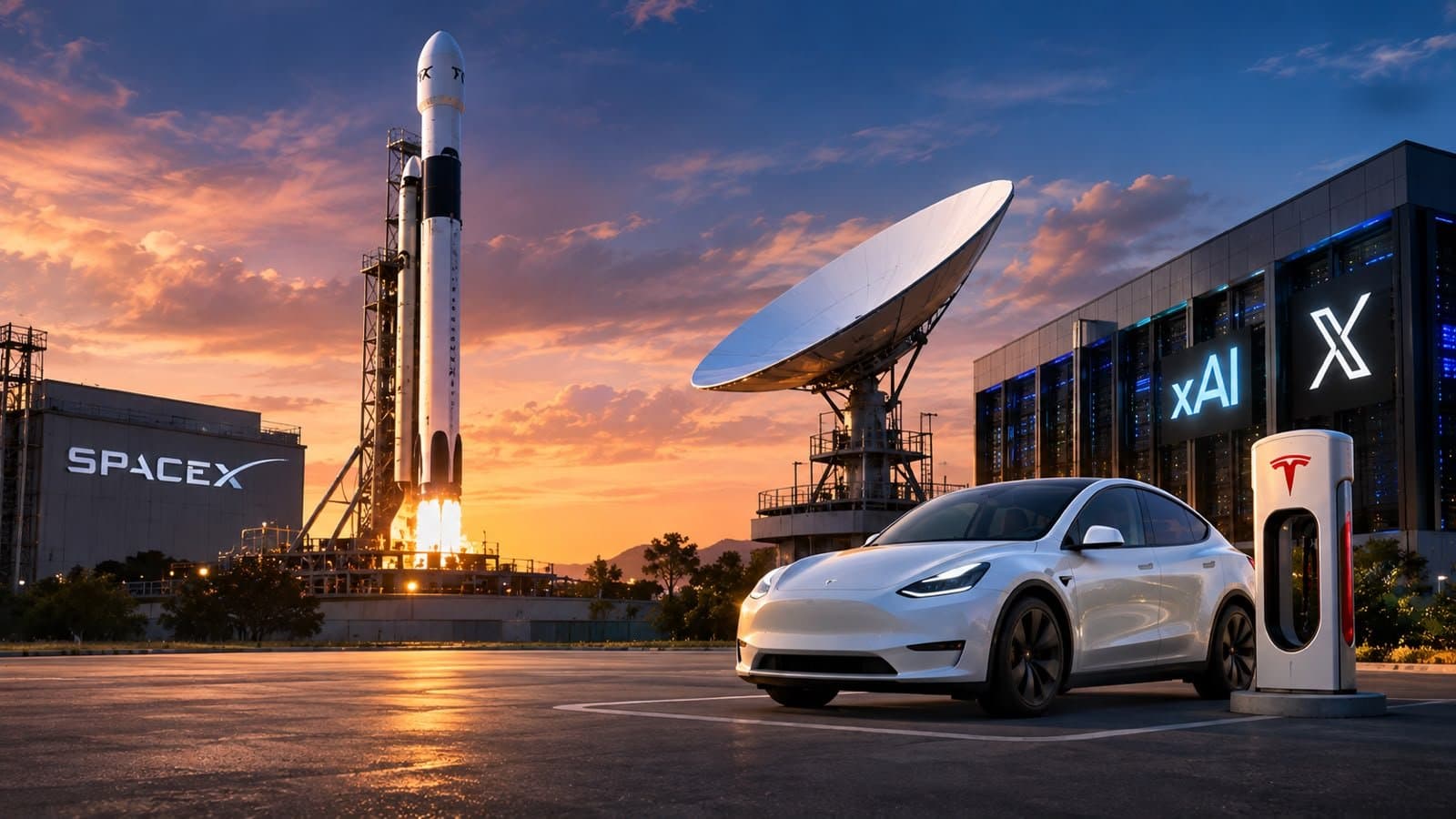
How Elon Musk has brought rockets, artificial intelligence, electric mobility and social media into an increasingly interconnected business empire, and why its long-term value will depend on more than technological ambition.
A satellite launched by SpaceX can eventually become part of a connectivity business. That business can generate recurring revenue, while the company’s computing ambitions require vast quantities of electricity, equipment and capital. Tesla manufactures energy storage systems that can serve companies across the wider Musk network. X, meanwhile, gives xAI access to a large digital distribution platform.
The connections are unusual. So is the concentration of strategic authority behind them.
Elon Musk’s businesses are increasingly difficult to assess in isolation, even though they remain separate legal entities with different shareholders and financial obligations. Their ambitions overlap across transport, communications, energy and artificial intelligence. Some relationships are already commercial; others remain strategic propositions.
This is the proposition behind the Musk Economy: a group of businesses whose potential advantage lies partly in the ability to coordinate assets and capabilities that competitors often have to assemble independently.
The investment case is more demanding. Shared ownership or a common founder does not automatically produce better economics. The value of the connections has to appear somewhere in the accounts: lower costs, higher utilisation, stronger margins, recurring revenue or superior returns on capital. Without that evidence, investors are being asked to pay for a corporate strategy whose financial benefits have yet to be established.
A connected group, not one company
The structure has changed considerably over the past two years.
In March 2025, xAI and X were brought under X.AI Holdings. SpaceX acquired X.AI Holdings in February 2026, placing the AI company and social platform within the SpaceX corporate structure. Tesla remains a separate publicly traded company.
Tesla’s investment in xAI also changed form after the acquisition. Its previously agreed investment of approximately $2 billion was converted into an investment in SpaceX common stock. Tesla completed the transaction on March 12, 2026, acquiring an ownership interest of less than 1%.
These arrangements are described in Tesla’s 2026 proxy statement and September 2026 Form 10-Q.
The corporate map is therefore more complicated than the popular shorthand of a single Musk conglomerate suggests. SpaceX owns the holding company that brought X and xAI together. Tesla is not a SpaceX subsidiary. Its connection is through a small equity investment and commercial relationships.
That distinction matters to shareholders. A strategic decision that benefits the wider group may not produce the same benefit for every company’s investors. Each board has its own duties, each balance sheet carries its own risks, and transactions between related businesses need to be assessed on their own terms.
The structure can make coordination easier. It can also make capital allocation harder to follow.
SpaceX: From launch provider to infrastructure business

SpaceX’s reusable rocket programme established its position in the launch market. Starlink has given the company a second, more recurring source of commercial activity.
Instead of depending solely on customers purchasing launch services, SpaceX operates a satellite network that sells connectivity to consumers, businesses and institutional users. Its control over launch operations gives it an unusual degree of influence over the deployment and replenishment of that network.
Starlink had approximately 10.3 million subscribers across 164 countries, territories and markets as of March 31, 2026, according to SpaceX’s IPO disclosures. The company reported approximately five million subscribers a year earlier. These are company-reported service figures, not a count of unique individuals. (SpaceX SEC prospectus)
The financial breakdown shows how far the business has moved beyond launch contracts. In 2025, SpaceX’s Connectivity segment, driven primarily by Starlink, generated $11.387 billion in revenue and $7.168 billion in Segment Adjusted EBITDA. The Space segment generated $4.086 billion in revenue and $653 million in Segment Adjusted EBITDA. (SpaceX SEC disclosures)
Connectivity was therefore the larger reported earnings contributor. SpaceX’s own launch capability supports that business by deploying satellites, but internal launches should not be mistaken for external launch sales.
There is a qualification to the earnings figures. Segment Adjusted EBITDA is a non-GAAP measure. It does not represent free cash flow and should not be read without considering the capital required to build, maintain and expand the network. SpaceX reported $4.178 billion of Connectivity capital expenditure in 2025, alongside $3.832 billion for its Space segment. The business has substantial operating scale, but it remains capital-intensive.
SpaceX’s public-market debut in June 2026 added a new layer of scrutiny. The company priced its shares at $135, with 638,888,888 shares issued in the completed offering. At the offer price, the transaction represented approximately $86.25 billion in gross offering value. SpaceX’s subsequent SEC filing reported net proceeds of $85.675 billion after $575 million in underwriting commissions and offering costs. Trading began on Nasdaq on June 12. (IPO pricing announcement; IPO closing announcement)
The proceeds are significant, but they are not a measure of the company’s valuation. Nor do they establish how efficiently the new capital will be deployed. Investors will have to judge the company by its operating performance, capital requirements and ability to convert infrastructure investment into durable cash generation.
AI: Revenue is arriving before profitability
The acquisition of xAI gives SpaceX a substantial position in artificial intelligence. The combination brings a model-development business and the X platform under the same corporate structure, while SpaceX is investing heavily in computing infrastructure.
The scale of that investment is visible in the accounts.
SpaceX reported $3.201 billion in AI segment revenue for 2025. The segment recorded a $6.355 billion operating loss and a $1.237 billion loss in Segment Adjusted EBITDA. Capital expenditure reached $12.727 billion. The company has described AI as a multi-year investment programme before sustained positive Segment Adjusted EBITDA is expected. (SpaceX SEC prospectus and segment disclosures)
The figures describe a business spending aggressively to build capacity ahead of expected demand. They do not establish that the strategy will fail. They do show that the financial burden is already substantial.
AI infrastructure requires advanced chips, data centres, networking equipment, electricity and specialist talent. Access to these resources can become a competitive advantage, particularly when supply is constrained. But owning infrastructure is only useful if it can be deployed productively and generate returns that justify its cost.
SpaceX’s wider operations may offer advantages in infrastructure planning and capital access. The accounting still has to show how those advantages translate into commercial performance. Internal demand, related-party supply arrangements and the allocation of investment costs all need to be understood before investors can assign value to the combined strategy.
The AI business has revenue. It has not yet demonstrated sustained segment-level profitability.
Tesla: The business behind the autonomy story
Tesla is the clearest example of the distance between an established operating business and the future ambitions that influence its valuation.
The company reported 2025 revenue of $94.827 billion, down from $97.690 billion in 2024. Automotive sales revenue fell to $65.821 billion from $72.480 billion. Energy generation and storage revenue, by contrast, rose to $12.771 billion from $10.086 billion. Tesla’s total gross profit was $17.094 billion, giving it a gross margin of approximately 18%. (Tesla 2025 Form 10-K)
The energy business is becoming more important to the company’s financial profile. Its reported gross margin was approximately 29.8% in 2025, materially above the company’s overall gross margin. That makes storage a meaningful growth opportunity, although its future contribution will depend on manufacturing capacity, project economics, competition and the timing of customer deployments.
Tesla’s automotive operations remain the largest revenue source. Their performance has to be considered alongside pricing, vehicle demand, product mix and competitive pressure, rather than being overshadowed by announcements about future products.
Autonomy and robotics complicate the valuation further. Tesla’s Q2 2026 update reported the start of Cybercab production and expansion of unsupervised robotaxi operations in Austin, Miami, Orlando and Tampa. These are company-reported deployment milestones. They do not establish that Tesla has a scaled, profitable autonomous transport service. That depends on safety, regulatory approval, utilisation, operating costs and customer adoption. (Tesla Q2 2026 update)
Investors are effectively assessing two businesses with different evidence bases: the automotive and energy operations that already report revenue, costs and margins, and the potential future businesses whose economics remain dependent on technical and commercial execution.
The second category may eventually be worth a great deal. Its value today depends on assumptions about when it can scale and how much capital will be required to get there.
The financial test: Manjushri Sharma
Manjushri Sharma, a SEBI-registered Research Analyst (INH000019497), argues that the Musk businesses should be assessed by separating current financial performance from future expectations. Her registration is listed on the SEBI register.
In her assessment, Tesla’s valuation increasingly reflects expectations around robotaxis, humanoid robotics and artificial intelligence, rather than automotive operations alone. SpaceX has a different commercial profile through reusable launch systems and Starlink, while xAI adds exposure to the AI market.
Sharma sees genuine potential in the connections between these businesses. Shared technology, infrastructure, engineering and data can reduce costs, shorten development timelines and create new revenue opportunities. But a common founder or strategic vision is not sufficient reason to assign a higher valuation.
She recommends examining whether the relationships produce stronger revenue, improved margins, better asset utilisation and higher returns on invested capital. Her preferred valuation approach is a sum-of-the-parts analysis, with each business assessed according to its own fundamentals, capital requirements and risks. Any additional premium for the connections between them should be supported by measurable benefits.
She also points to key-person concentration, management bandwidth, capital allocation and related-party transactions as risks that deserve attention when several businesses depend on the same individual.
Her analysis places the emphasis on financial outcomes rather than the appeal of the strategy. That is particularly relevant when the companies involved operate in industries where the potential market can be much larger than the revenue currently being earned.
X: Distribution, data and trust
X has a different role from the other businesses. Its commercial value rests on user attention, advertising, subscriptions and distribution. Its relationship with xAI offers a route to bring AI products to an existing audience, while the platform can potentially benefit from new AI features and services.
The opportunity is straightforward. A large digital platform can lower the cost of reaching customers and provide a ready-made channel for product distribution. But that advantage depends on retaining users and maintaining advertiser confidence.
The platform’s relationship with its owner has attracted scrutiny. In 2023, reporting by Platformer described changes to Twitter’s recommendation system that appeared to increase the visibility of Musk’s posts. The company also released part of its recommendation-system source code, which included an author_is_elon label. The existence of that label does not, by itself, establish preferential treatment. The episode illustrates why claims about algorithmic distribution need to be grounded in evidence rather than inferred from code labels alone. (Twitter’s source-code announcement; TechCrunch coverage)
For X, trust is not merely a reputational consideration. Advertiser confidence and user engagement have direct commercial consequences. If the platform is to serve as a distribution layer for xAI, its commercial credibility has to extend beyond the personal reach of its owner.
One founder, separate shareholder interests
The Musk Economy concentrates strategic authority around one individual. That can make decisions faster and allow businesses to coordinate around a shared direction. It also means investors in separate companies are exposed to risks linked to the same founder’s priorities, time and judgement.
SpaceX’s dual-class share structure gives Class A shares one vote each and Class B shares ten votes each. The prospectus also states that Class B holders can elect a majority of the board. Musk was expected to retain majority voting control after the offering. The structure gives public investors economic exposure without equivalent influence over corporate decisions. (SpaceX SEC prospectus)
That concentration of control becomes especially relevant when related companies transact with one another.
Tesla’s 2026 proxy statement disclosed approximately $143.3 million in revenue from SpaceX in 2025, primarily from vehicle sales, and approximately $430.1 million in revenue from xAI, primarily from Megapack sales. Tesla also disclosed commercial, licensing and support arrangements with these businesses. (Tesla 2026 proxy statement)
A later disclosure illustrates the scale of the commercial relationship. In the first nine months of 2026, Tesla recognised $626 million in revenue from SpaceX for Megapack purchases, with associated cost of revenue of $478 million.
At September 30, Tesla reported $729 million in accounts receivable from SpaceX and $648 million in deferred revenue. The filing explains that $588 million of the receivable related to Megapacks that had not yet been delivered. After excluding those undelivered products, the receivable would have been $141 million and deferred revenue $60 million. Tesla says the arrangements involve contractual billing milestones, including capacity reservations, and payment terms. (Tesla September 2026 Form 10-Q, Note 13)
The figures are not evidence of improper dealings. They show why the details of related-party arrangements matter. Investors need to understand the commercial rationale, the timing of payments and deliveries, and the way economic benefits are distributed between the companies.
A transaction can make strategic sense for the wider group while still requiring scrutiny from the shareholders of the company recording the revenue or committing the capital.
The AI analyst: separating evidence from narrative
Akshay Gulati, Founder of Superinvesting.ai, approaches the Musk Economy through the changing role of artificial intelligence in investment research.
Gulati argues that AI is changing the speed of research more than its underlying purpose. Models can process earnings calls, annual reports and regulatory filings quickly, identify inconsistencies and help analysts compare management commentary with reported financial results.
A model may flag optimistic growth commentary while receivables are rising, or identify strategic priorities that disappear from subsequent earnings calls. That can make research more efficient, but the output still needs to be checked against original documents. AI systems cannot reliably identify what management has chosen not to disclose, and they can generate incorrect figures or misleading interpretations.
As Gulati puts it, “AI does the reading. The judgement still has to come from a person.”
He recommends separating reported financial performance from promises made in presentations or product announcements. For Tesla, that means assessing the automotive and energy businesses independently from the potential of robotaxis, Optimus and AI.
He also advocates reverse valuation: working backwards from a share price to estimate the growth and profitability the market already expects, then comparing those assumptions with the company’s record of delivery.
Gulati warns that AI tools can reinforce market narratives if they are prompted with leading questions. Investors should require a bear case, independently verify the numbers and keep human judgement accountable.
The method is useful beyond Musk-related companies. The more compelling a corporate narrative becomes, the more important it is to establish what the accounts actually demonstrate.
What the Musk Economy means for India
For India, the Musk Economy has implications across connectivity, energy and artificial intelligence.
Starlink’s model could serve customers in areas where conventional broadband infrastructure is expensive or difficult to deploy. Its commercial prospects in India depend on licensing, spectrum and security requirements, pricing and the economics of providing service across a large and geographically diverse market.
Tesla’s energy storage business is relevant to India’s need for grid flexibility as renewable generation expands. Battery storage can help manage differences between electricity supply and demand. But the opportunity is not exclusive to Tesla. Domestic manufacturers, international suppliers and project developers are competing in a market where procurement costs, local manufacturing and execution will determine commercial outcomes.
AI presents a more fundamental infrastructure challenge. Computing capacity, reliable electricity and skilled talent will influence how quickly Indian companies can develop and deploy advanced systems. The Musk model shows the advantages that may come from controlling several layers of infrastructure. It also shows the financial burden of building them simultaneously.
For Indian businesses, the lesson is not to replicate the entire structure. It is to identify which capabilities create a durable advantage and where investment can produce an economic return.
What investors should watch
The Musk Economy is difficult to value because its businesses are at different stages of commercial development. Starlink has a substantial subscriber base and recurring connectivity revenue. SpaceX’s launch business supports the satellite network. Tesla has established automotive and energy operations, while autonomy and robotics remain dependent on further technical and commercial progress. AI is generating revenue but absorbing substantial capital.
A sum-of-the-parts approach is a sensible starting point. Connectivity should be assessed through subscriber growth, revenue per user, margins, capital intensity and cash generation. Launch services require analysis of external demand, launch cadence, pricing and operating costs. Tesla’s automotive and energy operations should be assessed separately from the future economics of autonomy. AI requires explicit assumptions about adoption, infrastructure spending and the time needed to produce sustainable earnings.
Investors also need to avoid counting the same prospective benefit more than once. A platform’s data may be valued as a strategic asset for AI development, while the AI business is separately valued on the assumption that it can use that data to attract customers. The economic value must ultimately be captured somewhere in the group, and the accounts should make that path increasingly visible.
The indicators worth following are therefore operational as well as financial: recurring revenue, operating margins, free cash flow, returns on invested capital, capital expenditure efficiency and the terms of related-party transactions. Voting control and independent oversight deserve equal attention.
The final test
Musk has assembled businesses with the potential to influence transport, communications, energy and computing. Their connections are unusual, and some already produce meaningful commercial activity. The financial evidence, however, is uneven: Starlink has become a substantial connectivity business, Tesla’s energy operations are expanding, and the AI segment is still absorbing large amounts of capital.
The market can assign value to what these companies may become. It should also demand evidence that the connections between them are improving the economics of what they already do.
The Musk Economy will not be judged by the number of industries it enters. It will be judged by how much lasting value those industries produce, and who gets to keep it.
Also Read:Beyond Sustainability: The Global Green Economy’s Industrial Transformation