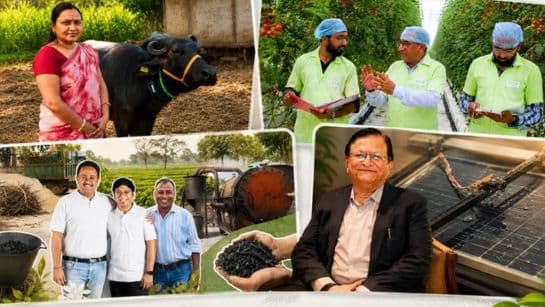
From an AI collar that catches sick cows before farmers even notice, to crop waste that now earns money instead of going up in smoke, India’s agri-tech moment is arriving from unexpected directions
Farming in India has always been a negotiation with uncertainty. Rainfall, soil quality, animal health, and market prices on the day you sell. For generations, the variables that determined whether a season succeeded or failed sat entirely outside a farmer’s control. That is starting to change, and the solutions coming through are less high-concept than practical.
A Farm That Does Not Need the Monsoon
Pravin Patel grew up watching the weather decide his family’s income. When he founded Brio Hydroponics in 2014, most people struggled to believe vegetables could grow without soil at all. A decade of demonstrations later, his climate-controlled, IoT-powered systems help farmers produce up to five times as much per acre while using 90% less water. The company now runs a 100-acre hydroponics park in Gujarat.
The Collar That Reads a Cow’s Health
A sick cow rarely shows obvious signs until the damage is done. Ashish Sonkusare, an IIT Bombay graduate who spent two decades in tech overseas, built eVerse.AI in Nagpur to close that gap. His connected collar tracks temperature and behaviour to flag illness early. A WhatsApp chatbot called CowGPT answers farmer questions through plain voice notes. The platform has reached over 22 lakh farmers and deployed 40,000 collars.
Bringing Dead Solar Panels Back to Life
Dr Harsh Sethi’s Mumbai-based TriNANO Technologies developed a nano-coating thinner than a human hair that boosts panel output by 4% and cuts cleaning water use by 55%, working on panels of any brand or age, including an 11-year-old installation in Madhya Pradesh that managers had nearly written off.
Crop Waste That Now Pays Farmers
Bengaluru-based RenewCred, founded by Abhimanyu Rathi and Yogendra Panchal, spent two years building verification systems to convert stubble burning into tradeable carbon credits. Farmers on the platform are expected to earn an additional Rs 30,000 to 45,000 annually, with around 100,000 carbon credits projected for this year alone.