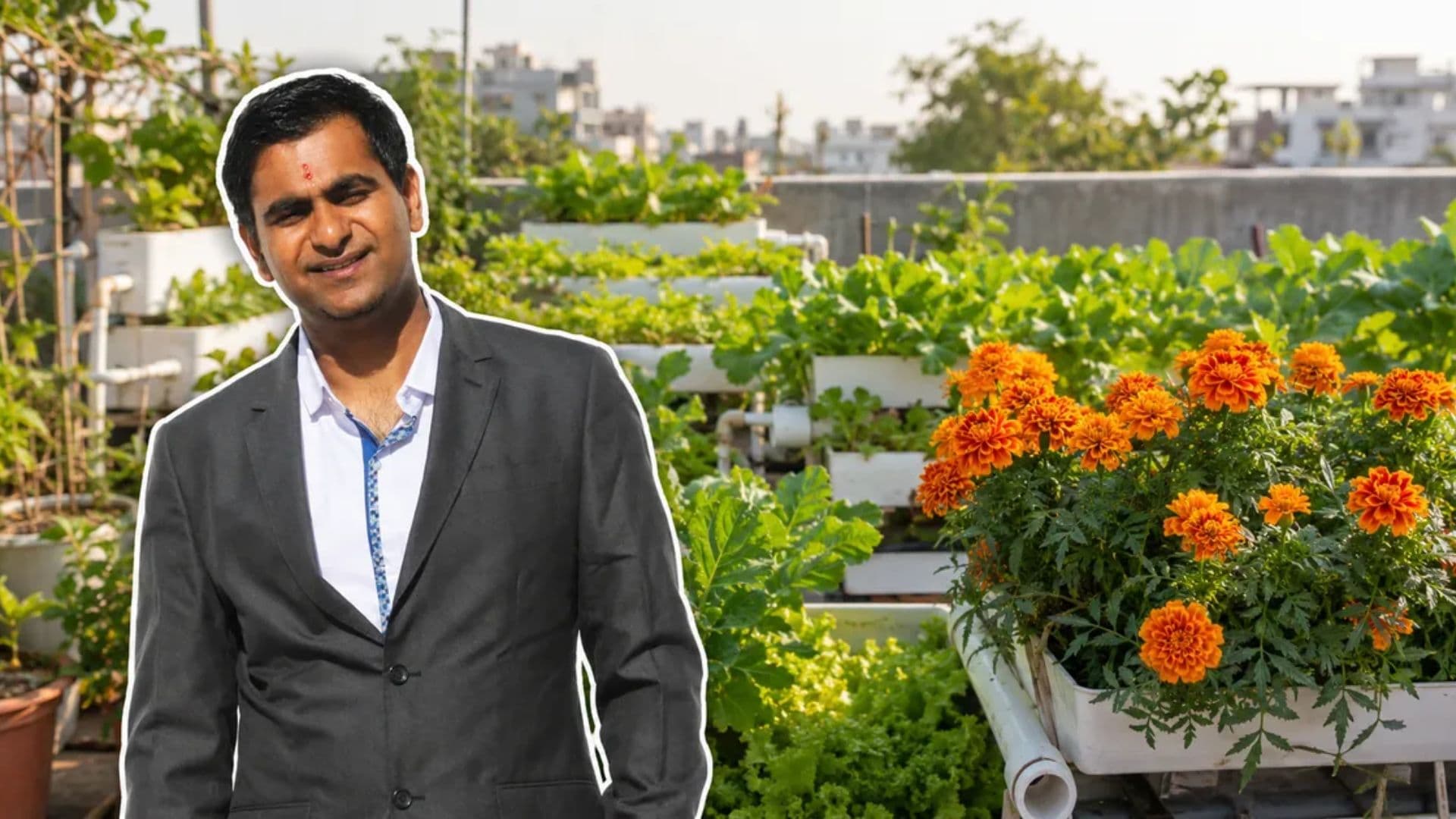
Dubey left his career after learning about heavy-metal contamination in urban vegetables, and now grows 2,500 plant varieties while training others to farm the same way
Shashank Dubey once held a stable corporate job in Delhi, but everything shifted after he came across an article detailing the health risks of vegetables grown on the polluted floodplains of the Yamuna river. Concerned about heavy metal contamination and its links to serious illness, and troubled by how dependent urban residents had become on packaged and fried foods, Dubey decided to take control of his own food source. After nearly a decade working as an electronics and communications engineer, he quit his job in 2018 and relocated to Vadodara to begin growing his own food, despite having no prior farming experience and limited space to work with.
Turning to Aquaponics
Dubey found an alternate way to grow vegetables by using aquaponics—a system that combines aquaculture (raising fish) with hydroponics (growing plants) in a closed-loop. Fish waste is converted to nitrate through a bacteria action which provides nutrients for non-soil grown plants as per the natural ecology of rivers. Along with iron nails, lime and eggshells he provides nutrients to the plants through bacteria culture and he calculates using this method requires at least 80 percent less water than traditional methods of agriculture.
A Thriving Terrace Farm
After spending six months researching the technique with help from ICAR-CAFRI Vadodara, Dubey initially farmed in a small indoor space before scaling up to a 2,000-square-foot commercial terrace setup seven months ago. He now cultivates around 2,500 varieties of plants, including leafy greens, medicinal herbs and flowers, harvesting approximately 500 kg of vegetables every month.
Teaching Others to Grow
Now Dubey offers training for urban residents interested in establishing aquaponics on their properties; having provided training to 35 trainees to date using both online and offline delivery, he continues to grow. The cost of establishing vertically increased Aquaponic systems is Rs 800 per square foot while horizontally it is approximately Rs 400. Not only does Dubey want to develop his own system but he also wants to decouple food supply by creating a large number of small, or medium, sized Aquaponic systems throughout urban areas.