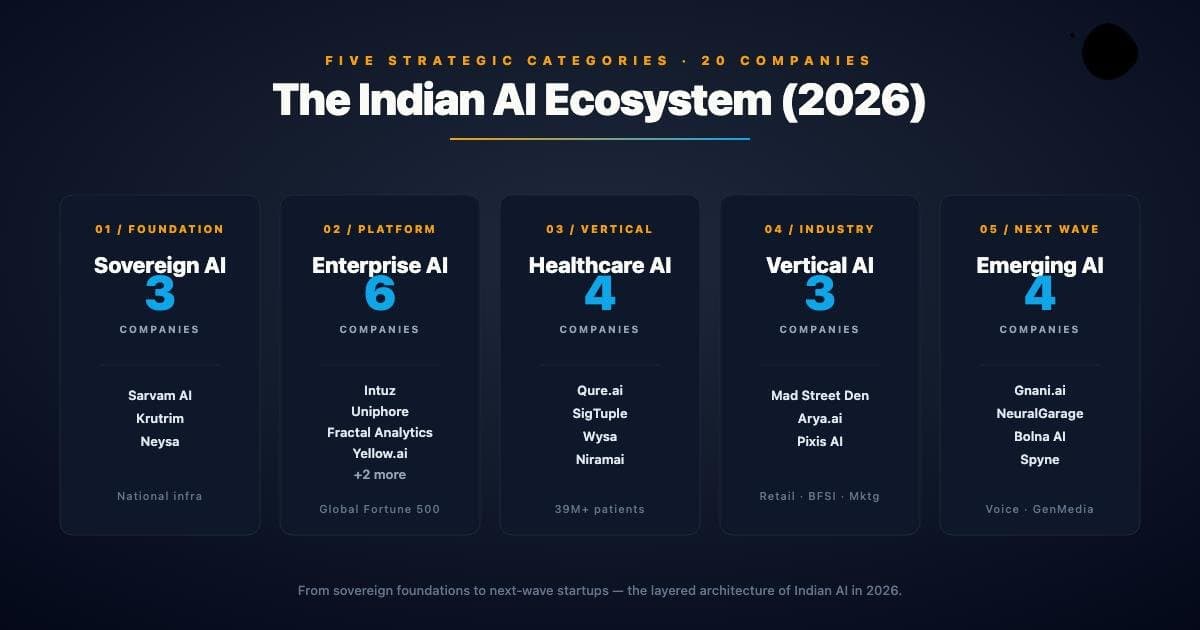
Indian AI startups are attracting more capital, but investment is concentrated in AI infrastructure, enterprise software, and developer tools that can sell internationally. The funding pattern suggests that investors are backing companies built in India for global customers, rather than mainly products designed for Indian consumers.
Why Indian AI Startups Are Attracting Bigger Cheques
Indian startups raised approximately $7.2 billion across 652 equity rounds in the first half of 2026. Funding rose 12% from the same period in 2025, even as the number of rounds fell 43%, according to Tracxn data reported by Fortune India.
AI was one of the main beneficiaries. Inc42 reported that Indian AI startups raised approximately $676 million across 57 deals in the first half of 2026, compared with $162 million across 30 deals in the same period of 2025.
Different databases report different totals because they classify AI, machine learning, and AI infrastructure differently. The common pattern is larger cheques going to fewer companies.
Emergent shows the funding pattern
Emergent develops an AI-powered software-creation platform. Users can describe an application in natural language, after which the platform helps build web and mobile products.
In July 2026, Emergent raised $130 million in a Series C round led by Creaegis. The round valued the company at $1.5 billion and took its total funding to $230 million, according to Business Standard.
According to TechCrunch, Emergent had:
- Approximately $120 million in annualised revenue.
- More than 200,000 paying customers.
- $230 million in total funding after the Series C.
Fortune India reported that more than 12 million applications had been built on the platform and that its users were spread across 190 countries.
Emergent is therefore not primarily an India-only consumer product. It is a global software business using India as a base for product development.
The enterprise-first pattern
Investors are concentrating on three broad categories.
AI infrastructure
Infrastructure companies provide computing, cloud, data-centre or model infrastructure to other AI businesses.
Neysa, an AI-cloud and computing-infrastructure company, entered the unicorn group in the first half of 2026, according to Tracxn reporting cited by Deccan Herald.
These companies can sell to enterprises, governments, research institutions, global technology companies, and other startups. Their revenue does not depend entirely on individual consumers paying for an AI application.
Developer tools
Emergent fits the developer-tools category. Its customers pay for software creation and productivity rather than for a general-purpose chatbot.
Potential revenue streams include:
- Subscriptions.
- Usage-based pricing.
- Enterprise plans.
- Team accounts.
- API access.
- Workflow integration.
A global customer base also allows these companies to price for international markets rather than relying mainly on Indian purchasing power.
Enterprise applications
Other AI companies are building tools for:
- Customer support.
- Voice automation.
- Sales.
- Compliance.
- Healthcare.
- Recruitment.
- Financial services.
- Document processing.
Enterprise customers may pay more because the product is linked to measurable outcomes such as lower operating costs or higher employee productivity.
Why consumer AI is harder to monetise
India has a large digital population, but consumer AI products face several challenges:
- Low willingness to pay.
- Expectations of free access.
- High computing and inference costs.
- Short-lived engagement.
- Fast imitation.
- Dependence on app stores and platforms.
- High customer-acquisition costs.
An individual may try an AI assistant without paying for it. A company may pay if the product reduces support costs, automates work, or increases output.
This is why enterprise customers are attractive to investors. Their purchasing decisions are connected to business budgets rather than personal willingness to subscribe.
Who is paying?
AI funding should be compared with paid usage, not just downloads or applications created.
For consumer products, investors should track:
- Free-to-paid conversion.
- Monthly recurring revenue.
- Retention.
- Average revenue per user.
- Cost per inference.
- Customer-acquisition cost.
For enterprise products, the more important indicators are:
- Number of paying organisations.
- Annual contract value.
- Renewal rate.
- Net revenue retention.
- Gross margin.
- Implementation cost.
- Customer concentration.
- Time from pilot to paid contract.
Emergent’s more than 200,000 paying customers are therefore more meaningful than its total application count. TechCrunch reported the customer figure.
India as a base, not always the market
India’s AI opportunity has two distinct parts.
The first is building global software and infrastructure from India. Emergent fits this model, with users across 190 countries, according to Fortune India. The second is solving India-specific problems in local languages, education, healthcare, agriculture, public services and small businesses.
The second opportunity may be strategically important but harder to monetise. Customers may include governments, small firms and price-sensitive consumers. Large usage does not necessarily produce high revenue. India may therefore become a major AI user even if many Indian AI companies earn most of their revenue from overseas customers.
Building for India: Sarvam AI

Sarvam AI offers an India-specific alternative to the global enterprise-AI model. It develops speech, translation and conversational-AI products across 22 Indian languages for enterprises, developers and public institutions. Sarvam’s product pages describe its language, speech and translation models, while the Government of India identifies Sarvam as one of the organisations selected under the IndiaAI Mission to develop indigenous foundation models.
In June 2026, Sarvam announced the first close of a $300-million Series B round, including $234 million raised at a reported $1.5-billion valuation. HCLTech led the round with a $150-million investment. Sarvam’s announcement and TechCrunch’s report confirmed the funding.
Sarvam’s challenge is to turn Indian-language capability into paid enterprise and government deployments. Its potential use cases include customer-service automation, document processing, financial services and public-service delivery. The company’s India focus may be an advantage, but its success will ultimately depend on enterprise contracts, renewals and margins after computing costs.
Valuation and Funding Risks for Indian AI Startups
Emergent’s reported valuation increased fivefold to $1.5 billion. Business Standard reported that the new valuation reflected rapid revenue and user growth. That may be justified if revenue, retention and margins continue to expand. It also creates a valuation risk if:
- Customer acquisition depends mainly on free usage.
- Enterprise pilots do not become long-term contracts.
- Computing costs remain high.
- Larger platforms copy the product.
- Customers build similar tools internally.
- Model providers capture most of the value.
- Valuations rise faster than recurring revenue.
The main risk is not that AI demand disappears. It is that many companies offer similar products and customers become unwilling to pay premium prices for features that are easy to replicate.
How to Evaluate Indian AI Startups
Investors should assess four areas:
Technology
- Is the product technically differentiated?
- Does it depend heavily on an external model?
- Does it own proprietary data?
- Does it have a defensible workflow or distribution advantage?
Customers
- Who pays?
- Are customers consumers, small businesses, or enterprises?
- Do customers renew?
- Are contracts recurring or project-based?
Economics
- What is revenue per customer?
- What is gross margin after inference costs?
- How expensive is implementation?
- How long does it take to recover customer-acquisition costs?
Scale
- Can the product expand internationally?
- Does revenue grow faster than infrastructure costs?
- Is the company dependent on one model provider?
- Can it serve larger customers without adding equivalent headcount?
Emergent has strong early indicators in paying customers, annualised revenue, and international reach. Investors will still need evidence of retention, gross margin and long-term contract quality.
Conclusion
Indian AI startups are attracting serious AI capital. The harder question is whether that capital is building durable businesses, or simply rewarding companies with the clearest global story. Ultimately, the winners will be determined not by how many people use their AI, but by how many customers are willing to keep paying for it.
Read More: Flipkart’s Super-App Gamble: Can Minutes, Eat In and Myntra Build One Profitable Commerce Ecosystem?