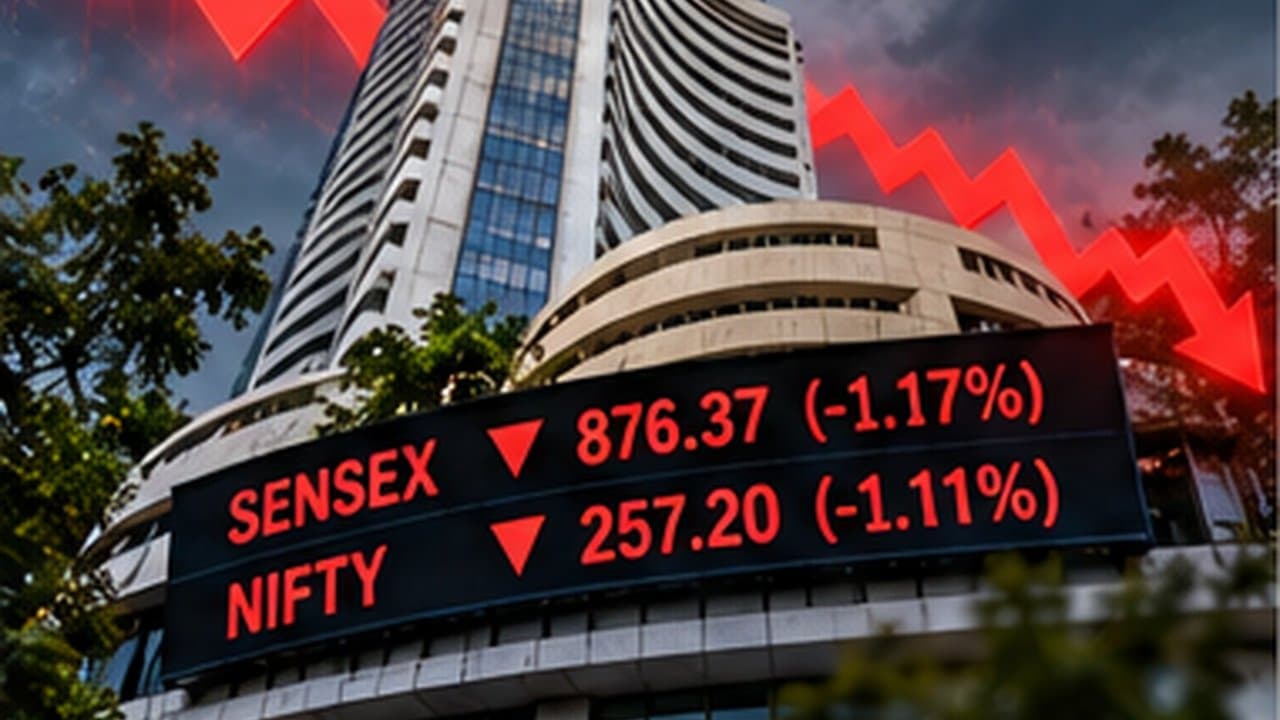
Indian stock markets suffered a sharp sell-off on Monday, with the Sensex tumbling 876 points and the Nifty 50 closing below the 22,900 mark as heavy selling in private-sector banks, elevated crude oil prices and weak global cues dampened investor sentiment.
The 30-share BSE Sensex fell 876.37 points, or 1.17 per cent, to settle at 73,852.90. The NSE Nifty 50 declined 257.20 points, or 1.11 per cent, to close at 22,888.95.
The decline reversed the momentum from the previous week’s rally, when both benchmark indices had recorded strong gains. The sell-off also came as investors assessed corporate earnings, persistent foreign portfolio investor outflows and uncertainty surrounding global energy markets.
ALSO READ: Over alleged Sensex expiry-day manipulation, SEBI bars two entities
Here are five key factors that weighed on Dalal Street.
1. Heavy selling in private-sector banks
Banking stocks were among the biggest drags on the benchmark indices, with investors reacting to quarterly earnings and concerns over margins.
Axis Bank fell around 4.2 per cent, while HDFC Bank declined approximately 2.3 per cent. Axis Bank’s share price weakened despite the lender reporting a 39.4 per cent increase in consolidated net profit to ₹7,704.67 crore for the second quarter of FY2026–27.
The reaction highlights an important feature of earnings season: strong headline profits do not always translate into gains if investors are concerned about margins, the outlook or whether results meet market expectations.

Analysts also pointed to profit-booking after the market’s strong rally in the previous week.
The weakness in heavyweight financial stocks had an outsized influence on the benchmark indices because of their substantial market representation.
ALSO READ: Sensex recovery: Indian stock market rebounds as Nifty rises after 18-month low
2. Crude oil near $110 a barrel revives inflation concerns
Elevated crude oil prices were another major source of concern for investors.
Brent crude traded close to $110 a barrel in recent sessions amid geopolitical tensions and uncertainty over global supplies.

For India, a major crude importer, expensive oil can increase the import bill, put pressure on the rupee and raise inflation risks.
Higher energy costs can also affect transportation, manufacturing, aviation and other businesses that rely heavily on fuel or petroleum-linked inputs.
If companies are unable to pass on the additional costs to customers, their profit margins may come under pressure.

Investors therefore remain sensitive to movements in crude oil, particularly when currency weakness and geopolitical uncertainty are already affecting market sentiment.
3. Foreign investor outflows continue to weigh on sentiment
Foreign portfolio investors have withdrawn approximately ₹52,100 crore from Indian equities in October so far, according to CDSL data cited in reports on Monday.
The outflows have exceeded the net withdrawals recorded in September and reflect concerns over the stronger US dollar, elevated oil prices and higher American bond yields.
Large foreign selling can create additional pressure on share prices, particularly when overseas funds reduce positions in widely held companies.
Domestic institutional investors have provided some support in recent weeks, helping Indian indices recover despite the foreign outflows. However, Monday’s decline demonstrated that domestic buying may not always be sufficient to prevent sharp corrections.
Investors will be watching whether foreign selling moderates or accelerates over the coming sessions.
4. Weak global cues and elevated US bond yields
Global market conditions have added to the uncertainty surrounding Indian equities.
Higher US Treasury yields can make dollar-denominated assets more attractive relative to emerging-market investments. A stronger dollar can also complicate the outlook for currencies such as the Indian rupee.

At the same time, uncertainty over geopolitical developments, energy supplies and the outlook for global economic growth has encouraged investors to reassess risk.
These factors can influence foreign capital flows and the valuation investors are willing to assign to Indian companies.
However, global cues are only part of the explanation for Monday’s decline. Domestic earnings announcements and sector-specific developments also played an important role.
5. Profit-booking after last week’s rally
The sell-off followed a strong week for Indian equities, when the Sensex and Nifty registered substantial gains.
After a sharp rally, some investors may choose to lock in profits, particularly when fresh concerns emerge over corporate earnings or global economic conditions.

Monday’s decline therefore reflected both new uncertainties and the unwinding of positions built during the recovery.
Market volatility also increased ahead of the weekly derivatives expiry, adding to the possibility of sharp moves in individual stocks and benchmark indices.
A single session of profit-booking does not necessarily signal the start of a prolonged bear market. The direction of subsequent trading will depend on earnings, oil prices, foreign flows and global risk appetite.
Which stocks and sectors were hit hardest?
Private-sector banks and information technology stocks were among the notable areas of weakness.
Axis Bank and Tata Motors Passenger Vehicles were among the major Nifty 50 laggards. Infosys also came under pressure, while the Nifty IT index declined approximately 1.3 per cent.
The broader market weakened as well, with small-cap and mid-cap indices recording losses.
Public-sector banks were a notable exception. The PSU Bank index advanced, supported by gains in lenders including Punjab National Bank and Union Bank of India after their earnings announcements.
The divergence shows that the session was not characterised by uniform selling across every financial stock. Investors continued to distinguish between individual companies based on their results and outlook.
What should investors watch next?
The next phase of trading is likely to depend on a combination of domestic and international developments.
Crude oil prices: A sustained rise could increase India’s import costs and revive inflation concerns. A meaningful decline could ease some of the pressure on sentiment.
Foreign investor flows: A reduction in net selling would help improve confidence, although daily flow data alone cannot establish a lasting trend.
Corporate earnings: Investors will assess whether companies can meet expectations despite higher input costs and uncertain demand.
Rupee and bond yields: Currency movements and government bond yields will provide further clues about financial conditions and the outlook for capital flows.
Global developments: Geopolitical tensions, US monetary-policy expectations and movements in global equities will remain important external influences.
Is this the beginning of a deeper market correction?
Monday’s fall is a warning that the recovery remains vulnerable to external shocks and earnings-related disappointments. However, it is too early to conclude from one trading session that a prolonged correction is inevitable.
The market’s next direction will depend on whether the selling remains concentrated in particular sectors or broadens further, and whether domestic investors can continue absorbing overseas outflows.
For retail investors, the immediate lesson is to avoid making rushed decisions based solely on a sharp daily decline. Portfolio decisions should reflect individual risk tolerance, investment horizon and the underlying fundamentals of the companies held.
Dalal Street now faces a combination of expensive crude, foreign capital withdrawals and demanding earnings expectations. Whether these pressures ease or intensify will determine if Monday’s sell-off remains a temporary setback or develops into a more sustained period of weakness.