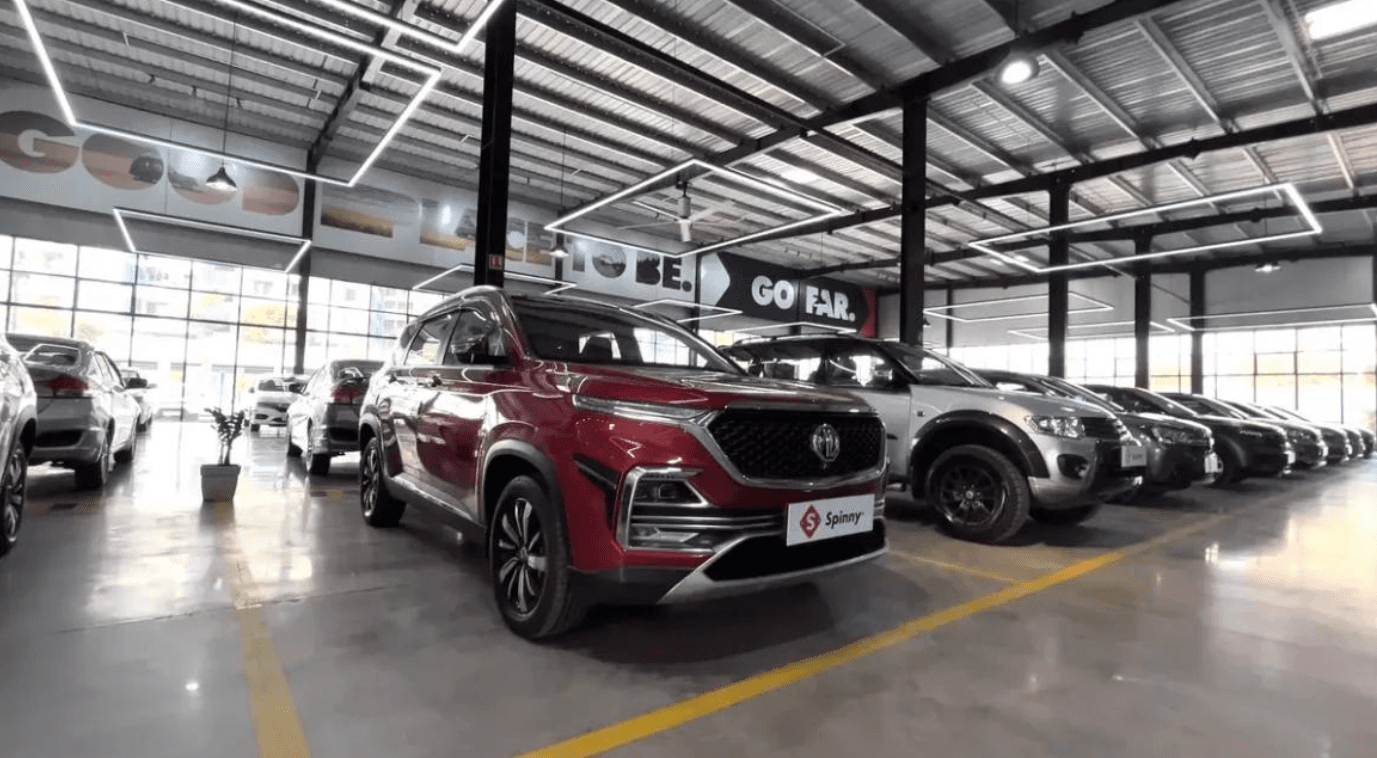
Spinny’s proposed IPO will test whether an inventory-led used-car retailer can become sustainably profitable in India. The company sells cars, but its real challenge is not finding buyers. It is buying the right cars, refurbishing them efficiently, selling them quickly, and earning enough from financing, insurance, and warranties to cover the cost of holding inventory.
What Spinny has filed
Spinny’s parent, Valuedrive Technologies, has confidentially filed IPO papers with SEBI. Reports say the company is targeting an issue of ₹2,500–3,000 crore, potentially split between a fresh issue and an offer for sale, with a possible listing in 2027. Inc42 reported the confidential filing.
The Economic Times later reported that the target issue size could be ₹3,000–3,500 crore. The Economic Times reported the updated target.
Spinny has not publicly disclosed its IPO size, valuation, or final structure. The company is expected to use fresh capital to expand its presence across India. The Economic Times reported the potential use of proceeds.
What Spinny actually does
Spinny is not a classifieds marketplace. It is an inventory-led, full-stack used-car retailer.
It buys cars directly from consumers, inspects them, refurbishes them, holds them as inventory, and sells them to buyers. It also offers financing, insurance, warranties, servicing, ownership transfer, and doorstep delivery. Inc42 described the full-stack model.
The company sells close to 15,000 cars a month and operates across 25 cities. It sources vehicles from more than 100 seller cities. The New Indian Express reported the operating scale.
That model gives Spinny control over quality, pricing, and customer experience. But it also means every car on its lot is capital tied up until it sells.
How Spinny makes money
Spinny’s largest revenue line is simple: it sells cars.
In FY25, revenue from contracts with customers was ₹4,650 crore. Nearly 98% came from car sales. Commission and other income remained relatively small. Inc42 reported the revenue mix.
The company’s basic economics are:
Gross spread = selling price – purchase price – refurbishment cost
Spinny earns money when the spread between what it pays for a car and what it sells it for is large enough to cover logistics, inventory financing, marketing, warranties, and operating costs.
But the headline revenue number can be misleading. Because Spinny owns the cars, it records the full selling price as revenue. Most of that revenue goes straight back into buying inventory.
In FY25, Spinny spent ₹4,304 crore on purchasing goods, including ₹4,250 crore on stock-in-trade. It also spent ₹136.8 crore on direct costs such as refurbishment, logistics, and warranty. Inc42 reported the cost structure. That means procurement consumed more than 90% of revenue from contracts with customers.
The revenue is not marketplace GMV
Spinny’s revenue is not the same as marketplace GMV.
A classifieds platform such as CarTrade earns a commission or lead fee when it connects a buyer and seller. It does not own the car.
Spinny, by contrast, buys the car, refurbishes it, and sells it. When the sale happens, the full vehicle price enters revenue. This is why Spinny’s revenue looks much larger than an asset-light marketplace with a similar transaction volume. It also explains why its margins look thinner.
The company changed its revenue-recognition approach for its cash-and-carry business in FY23, beginning to recognise the full selling price of vehicles rather than only commissions. Inventiva explained the accounting change.
The financial picture
Spinny’s revenue is growing, but it is still loss-making.
Spinny’s FY25 net loss of ₹423.8 crore was about 9% of operating revenue. StartupFox calculated the loss as a share of revenue. The company has not yet released audited FY26 results. But sources told Inc42 that operating revenue reached about ₹6,000 crore in FY26, growing nearly 29% year on year. Inc42 reported the estimated FY26 revenue.
The Hindu BusinessLine reported that Spinny was estimated to have remained loss-making in FY26, with a net loss of roughly ₹350–400 crore. The Hindu BusinessLine reported the estimated FY26 loss. These FY26 figures are estimates, not audited disclosures.
Why inventory is the core risk

Spinny’s biggest advantage is also its biggest risk.
Owning inventory lets the company control inspection, refurbishment, pricing, warranties, and delivery. That creates trust in a market where buyers often worry about hidden defects, odometer tampering, and unclear ownership history.
But inventory also creates:
- Working-capital needs.
- Financing costs.
- Storage and logistics costs.
- Refurbishment-cost variability.
- Price-decline risk.
- Inventory-ageing risk.
- Resale-value risk.
A used car loses value over time. If Spinny holds a car too long, its margin can disappear.
That is why inventory turnover matters as much as gross margin. A car that sells quickly at a modest spread may be better than a car that sits unsold for months at a higher asking price.
Refurbishment: cost or advantage?
Refurbishment is central to Spinny’s model.
The company buys used cars, inspects them, and repairs them before sale. It offers a five-day money-back guarantee and a one-year comprehensive service warranty. Inventiva described Spinny’s customer proposition.
Refurbishment improves trust and helps Spinny justify a fixed price. But it also adds cost and complexity.
The company must decide which cars to buy, how much to spend on repairs and how quickly to sell them. A poorly chosen car can consume more refurbishment cost than the eventual sale spread can support.
In FY25, Spinny spent ₹136.8 crore on direct costs such as refurbishment, logistics and warranty. Inc42 reported the direct-cost figure.
That is small relative to procurement, but it is still a meaningful cost that affects per-car profitability.
Financing: the higher-margin opportunity
Financing is where used-car platforms can earn more than they do from the vehicle sale itself.
Spinny facilitates financing and insurance and offers warranty and other protection products. Inc42 described the ancillary businesses.
Used-car purchases are highly finance-dependent. Financing can improve conversion and create additional revenue through referral fees, commissions, or distribution income. Inventiva explained the financing opportunity.
The key distinction is between:
- Distribution income: Spinny refers a customer to a lender and earns a commission.
- Balance-sheet lending: Spinny lends directly and earns interest, but carries credit risk.
Spinny operates Spinny Capital, its lending arm. StockAnalysis described the lending business.
If Spinny uses a distribution model, it earns fee income without credit risk. If it lends on its own balance sheet, it can earn more but must manage defaults, provisioning, and capital requirements.
Warranties and after-sales services
Warranties are another way to earn from the same customer.
Spinny offers a one-year comprehensive service warranty, with newer Assured+ categories adding roadside assistance and longer powertrain coverage. Inventiva described the warranty products.
Warranties can improve buyer confidence and increase conversion. They can also generate recurring revenue if customers buy extended coverage or return for servicing.
Spinny acquired vehicle-servicing startup GoMechanic in November 2025 for ₹450 crore in cash and stock. The Economic Times reported the acquisition.
That acquisition extends Spinny’s model beyond the initial sale. A customer who buys a car from Spinny may later use GoMechanic for servicing, repairs, and maintenance.
This is the lifetime-value argument: Spinny wants to earn not only when it sells a car, but throughout the ownership cycle.
How competitors compare
Cars24 is Spinny’s closest large competitor, but it has been moving in a different direction.
Cars24’s FY26 revenue from operations fell more than 18% to ₹5,092 crore. But its adjusted net revenue grew 27% to ₹1,411 crore, while adjusted EBITDA loss narrowed to ₹200 crore from ₹475 crore. Moneycontrol reported Cars24’s FY26 performance.
The difference is the business model.
Cars24 shifted its wholesale business from an inventory-led model to a commission-based model in mid-FY26. That reduced headline revenue but improved capital efficiency. Inc42 reported the model shift.
Cars24 also earns from financing, insurance, warranties, service fees, parking fees, lead fees, and listing fees. Its ancillary automotive offerings generated ₹653 crore in FY26, up 34% from ₹487 crore in FY25. MediaNama reported the ancillary revenue.
CarDekho is more asset-light.
It operates across new and used-car transactions, automotive classifieds, and related services. Its model is largely marketplace-led, earning commissions from buyer-seller or dealer transactions. The New Indian Express described CarDekho’s model. CarDekho also owns InsuranceDekho, which sells insurance, and Rupyy, which provides used-car financing. Industry analysis described the financing and insurance businesses.
That gives CarDekho lower working-capital requirements and higher operating leverage than an inventory-led retailer.
But it also means CarDekho has less control over the vehicle itself. It cannot guarantee the same end-to-end quality, refurbishment and ownership experience that Spinny offers.
The market opportunity
India’s used-car market is large and still mostly unorganised.
Mordor Intelligence estimated the market at $41.74 billion in 2026, rising to $82.88 billion by 2031, a compound annual growth rate of 14.72%. Mordor Intelligence reported the market forecast.
Unorganised local dealers held 70.83% of the market in 2025. Online platforms are expected to grow fastest, at a 26.85% CAGR through 2031. Mordor Intelligence reported the channel mix.
That is the opportunity for organised players such as Spinny, Cars24, CarDekho and CarTrade. They can offer inspection, certification, transparent pricing, financing, warranties, and ownership transfer—services that informal dealers often do not provide.
Conclusion
Spinny makes money primarily by buying used cars, refurbishing them, and selling them at a higher price. Financing, insurance, warranties, and servicing are important additions, but car sales still generate nearly 98% of its revenue.
That makes Spinny a retailer, not a marketplace. Its revenue is large because it owns the cars it sells, but its margins are thin because procurement consumes most of that revenue.
The company’s IPO will test whether a full-stack used-car retailer can achieve sustainable profitability in India. The answer depends less on how many cars Spinny sells and more on how quickly it sells them, how efficiently it refurbishes them, and how much it earns from the customer after the sale.
Read More: ShareChat’s $400 Million IPO Plan: From Social Network to Micro-Drama Business