APL Apollo expects to raise ₹28,000 crore to buy Tata Steel’s downstream assets. Once Tata Steel takes control, that financing could become group debt.
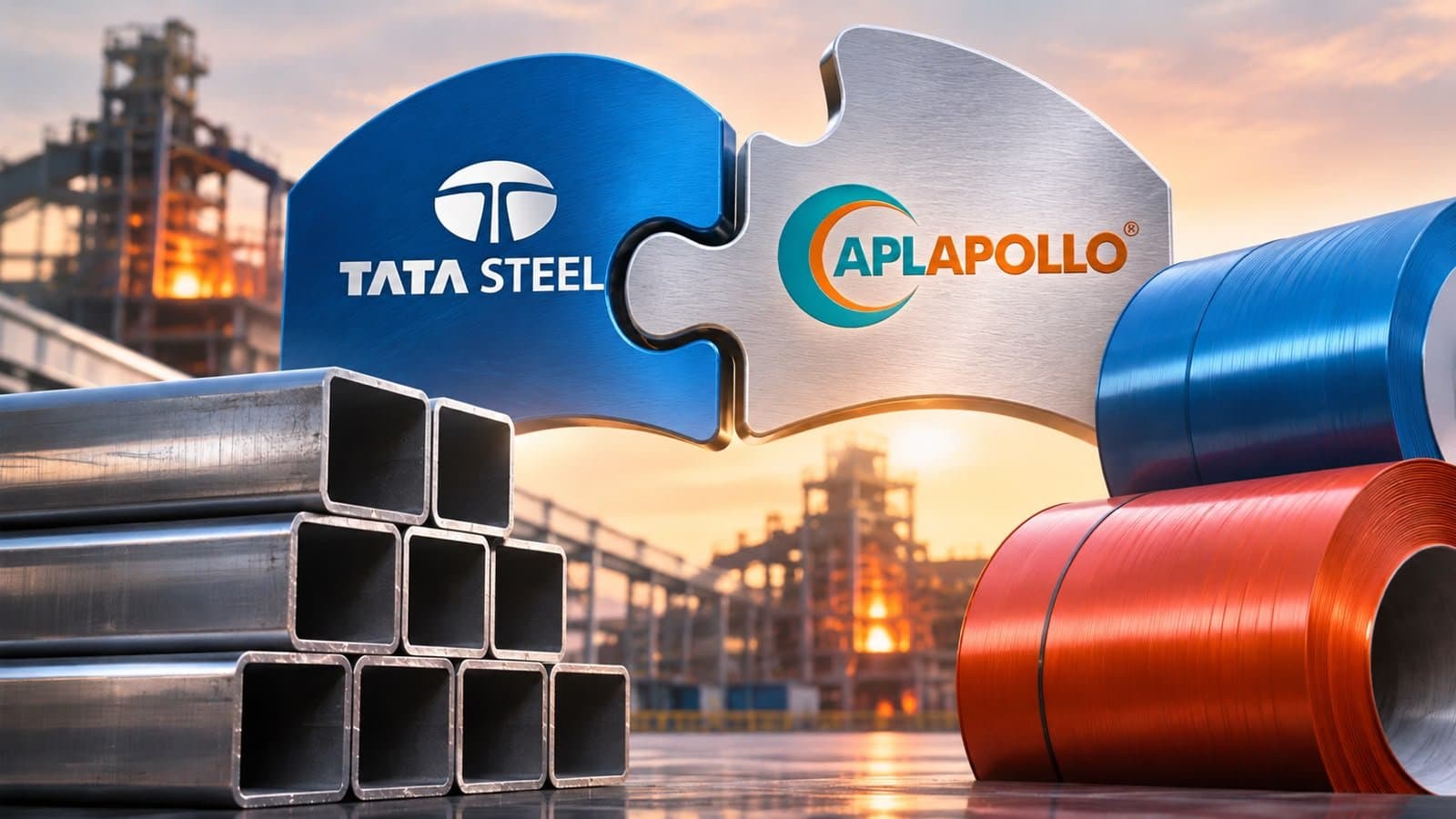
Tata Steel is selling its tubes and colour-coated steel businesses to APL Apollo Tubes. At the same time, it is moving to acquire control of APL Apollo.
The unusual feature of the deal is that the buyer of Tata Steel’s assets is set to become a Tata Steel subsidiary. APL Apollo expects to fund the ₹28,000 crore purchase through acquisition financing, then replace that funding with long-term capitalisation.
APL Apollo may be able to raise the money. The harder question is what happens to the borrowing once Tata Steel consolidates the company.
Under agreements announced on November 22, APL Apollo will acquire Tata Steel’s steel tubes business for up to ₹11,700 crore and Tata Steel Colors for ₹16,300 crore. The businesses have a combined capacity of 2.5 million tonnes a year, according to Tata Steel.
In its investor presentation, APL Apollo outlined acquisition financing of about ₹28,000 crore, to be followed by long-term capitalisation intended to reduce balance-sheet risk. Final financing terms have not been disclosed.
The presentation values the acquired businesses at 24.8 times projected FY27 EV/EBITDA. A multiple that high leaves little room for slippage. The businesses will need to deliver earnings and cash flow quickly enough to support the enlarged balance sheet.
Tata Steel’s stake purchase could cost ₹32,266 crore
On November 23, Tata Steel agreed to acquire up to 26.38% of APL Apollo’s expanded voting share capital, on a fully diluted basis, from promoter-group entity S Gupta Holding for ₹15,510.61 crore, at ₹2,100 a share.
It will also make a mandatory open offer for up to 26% of the company at ₹2,301.40 a share, worth up to ₹16,755.66 crore.
If the open offer is fully accepted and all promoter tranches are completed, Tata Steel’s holding could rise to about 52.38%. Together, the promoter stake purchase and open offer represent a potential gross outlay of about ₹32,266 crore.
That is about ₹4,266 crore more than the ₹28,000 crore asset-sale consideration. The comparison is not a net cash figure, however. The stake purchase, open offer and asset transfer are separate transaction legs, and their effect on the consolidated accounts depends on how and when they close.
The promoter stake will be acquired in three tranches. The first, 9.91%, was executed through a block deal on November 23. Those shares are to be held in an escrow demat account, and Tata Steel will not exercise voting rights while they remain there.
The second tranche, 11.90%, is subject to conditions and approvals. The final 4.57% is due to transfer on or before March 31, 2028, subject to the agreement’s conditions.
According to the open-offer announcement, control is linked to the closing of the second tranche. Executing the first block deal does not, by itself, require Tata Steel to consolidate APL Apollo.
The debt question is about consolidation
APL Apollo is the proposed borrower. Under Ind AS 110, a parent consolidates entities it controls, including their assets and liabilities.
Once Tata Steel obtains control, APL Apollo’s external borrowings would generally appear in Tata Steel’s consolidated accounts from that date. APL Apollo would remain the legal borrower unless Tata Steel separately assumes or guarantees the debt, but the borrowings would become part of the group’s consolidated financial exposure.
That exposure has limits. The debt would not automatically move onto Tata Steel’s standalone balance sheet, and the proposed ₹28,000 crore financing is not consolidated debt today. The accounting effect depends on when control is obtained and how the linked transactions close.
The order of closing has a second consequence. If the asset transfer completes after Tata Steel controls APL Apollo, the ₹28,000 crore payment would generally be eliminated as an intra-group transaction in consolidated accounts. The external borrowing used to fund it would not be eliminated.
Tata Steel could receive cash in its standalone accounts, but the group would not recognise an external sale simply by moving the businesses between entities it controls. The assets would remain within the group, while the acquisition financing raised from outside lenders would remain.
This is the balance-sheet risk in the structure. A sale that brings cash into Tata Steel’s standalone books may not reduce the group’s debt.
The earnings have to catch up with the financing
The industrial rationale is clear. Tata Steel wants a larger presence in downstream products, where processing and product mix can earn more than commodity steel alone. APL Apollo gains assets, capacity and access to Tata Steel’s product range.
The acquired businesses, however, must now support a substantial financing burden.
APL Apollo’s presentation puts the acquired businesses’ FY26 revenue at ₹11,088 crore and projects ₹13,989 crore for FY27. Using the ₹28,000 crore transaction value as a proxy for enterprise value, the stated 24.8-times multiple implies FY27 EBITDA of roughly ₹1,130 crore. This is a Capital Insider calculation, not an EBITDA figure separately reported by the companies.
EBITDA is not the same as cash available to repay debt. It is measured before interest, taxes, capital expenditure and working-capital needs.
The financing terms have not been disclosed. At an illustrative interest rate of 8%, ₹28,000 crore of debt would cost about ₹2,240 crore a year in interest, roughly twice the implied EBITDA of the acquired businesses.
That does not mean the group cannot service the debt. APL Apollo’s existing operations would also contribute cash, and the company has said it plans to replace the initial acquisition financing with long-term capitalisation. The margin for error will depend on the final interest rate, repayment schedule, refinancing conditions and how quickly the acquired assets deliver earnings.
Investors were not convinced on the first day. APL Apollo shares fell nearly 20% on November 23, trading as low as ₹1,702.40 on the NSE by early afternoon, according to PTI. Tata Steel fell more than 8%. Market reports cited concerns over the funding and valuation of the acquisition.
Samir Arora, founder and chief investment officer of Helios Capital, publicly criticised the deal on social media as both stocks fell, according to Business Upturn.
For APL Apollo’s minority shareholders, the question is whether the enlarged company can absorb the debt without sacrificing returns or delaying investment. For Tata Steel shareholders, it is whether the downstream expansion will earn enough to justify the capital committed and the added consolidated exposure.
The deal could strengthen Tata Steel’s position in higher-value steel products. But the financing cannot be judged only by which company raises the loan.
APL Apollo may borrow the money. Once Tata Steel takes control, the debt comes home to the group.
Sources: Tata Steel transaction announcement; Tata Steel board filing; APL Apollo investor presentation; open-offer announcement; Ind AS 110.PTI market report (November 23, 2026)
Implied EBITDA and the illustrative interest calculation are Capital Insider estimates. Financing terms and final transaction sequencing remain subject to company disclosures and closing conditions.
Also Read:The Leverage Illusion: Why the One-Person Startup Hits a Scale Ceiling