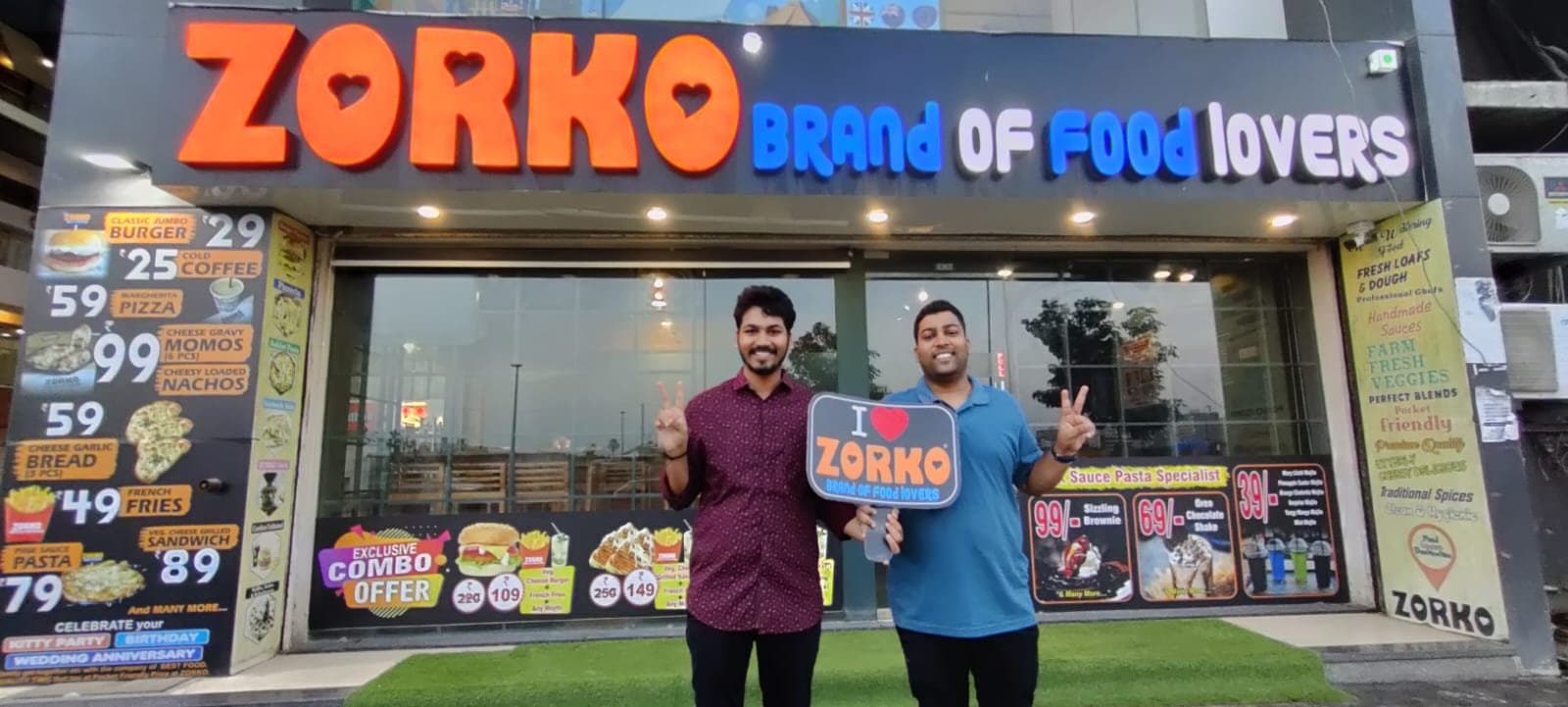
Story of Zorko’s Rise: In the contemporary Indian startup ecosystem, particularly within the fast-growing quick service restaurant (QSR) sector, many founders focus heavily on chasing inflated valuations rather than constructing sustainable corporate enterprise.
Millions of dollars are routinely funneled into aggressive customer acquisition campaigns and steep discounting strategies. In this rapid race for top-line market expansion, foundational financial principles including unit economics, gross margins, and positive cash flow are frequently overlooked.
Many founders operate under the assumption that venture capital is an indispensable operating engine rather than a temporary growth accelerator. However, capital markets analysis suggests that venture capital is merely a tool rather than a standalone business model.
While external funding can certainly accelerate expansion, it can never substitute for a strong, inherently profitable operational foundation. Rejecting the prevailing norm of capital burn, Zorko was founded on the fundamental principle that a genuine business must expand organically on its own earnings rather than surviving on continuous external investor infusions.
By ensuring that every single store location is designed to be self-sustaining and profitable from day one, Zorko established a highly resilient alternative framework for corporate growth.

Tapping the Unseen Demand Across Regional India
A crucial driver of this growth strategy lies in identifying and serving massive consumer demand across non-metropolitan geographies. While mainstream QSR chains historically concentrated their footprints within major metropolitan centers, substantial appetite for fast-food staples already existed throughout regional markets.
Consumers residing in Tier-2, Tier-3, and Tier-4 cities were fully aware of popular QSR products like pizzas, burgers, and sandwiches, and actively desired access to them. The core obstacle in these markets was never a lack of consumer appetite, but rather a severe lack of physical accessibility.
Established QSR brands typically operate with high capital investment requirements and steep ongoing operating expenditures, rendering expansion into smaller regional markets commercially difficult. By recognizing that accessibility rather than demand generation was the primary hurdle, Zorko engineered an efficient business model capable of expanding seamlessly into smaller Indian cities.
Democratising Middle-Class Entrepreneurship at Scale
To solve the accessibility challenge across non-metro regions, democratising entrepreneurship was established as a deliberate business decision rather than an operational coincidence.
Entrepreneurial ambition across India is by no means limited to major metropolitan hubs. Individuals living in regional centers such as Surat, Raipur, Ratlam, Indore, Nagpur, and countless other towns possess immense ambition, strong work ethic, and the determination to build local enterprises.
However, aspiring local business owners are frequently priced out of commercial franchise opportunities by exorbitant entry costs. To remove this entry barrier, the operational setup was intentionally structured to be financially affordable for a middle-class family while remaining commercially viable and highly profitable for the franchise partner.
By prioritizing accessibility to business ownership, Zorko transformed local middle-class partners into the primary engine of national expansion.

Uantifying Network Scale: Self-Funded Expansion
According to the founder’s operational narrative, the brand’s network expansion was driven entirely through organic earnings and unit-level cash flow rather than reliance on external capital markets.
In the founder’s account, the enterprise scaled to a footprint of over 500 outlets operating across more than 250 cities in 24+ states, accomplished without securing external venture capital or private equity funding.
To document unit-level viability and store performance across these regional markets, the founder points to over 400 video testimonials published by franchise partners.
Evaluated from a financial perspective, this network scale indicates that multi-state physical outlet density can be generated through self-sustaining store revenue and disciplined unit economics.
Resisting Term Sheets to Preserve Brand Integrity
As the company achieved rapid national expansion without external equity, numerous private equity and venture capital investors approached the leadership team with attractive capital offers, high valuation figures, and aggressive expansion roadmaps.
However, management consistently chose to say no to institutional capital. The decision to decline external investor funding stems from a commitment to maintaining control over operational priorities.
When a business becomes dependent on external capital, its focus frequently shifts away from serving customers and franchise partners toward satisfying investor expectations and delivering rapid short-term returns.
This investor pressure often compromises long-term business health and damages core brand values. By turning down term sheets, Zorko protected the soul of the brand, prioritized partner profitability, and proved that building a self-reliant enterprise on one’s own terms offers a far more sustainable path to corporate success
Also Read: Chai Sutta Bar’s co-founder AnubhavDubey