Battery Smart’s IPO will test one question: is battery swapping a business that can scale, or a capital-heavy battery rental scheme? The answer depends less on how many stations or drivers it has and more on one number. Does each battery earn enough swaps in its life to pay for itself, its degradation, its financing, and its replacement?
Why now
Battery Smart is likely to file draft papers with SEBI in September or October, according to a PTI report. SBI Capital Markets is the lead merchant banker, and the filing is expected to use FY26 and June-quarter financials. As of 13 October, Inc42’s IPO tracker lists the company among startups still in the pipeline, with plans that first surfaced in August 2026.
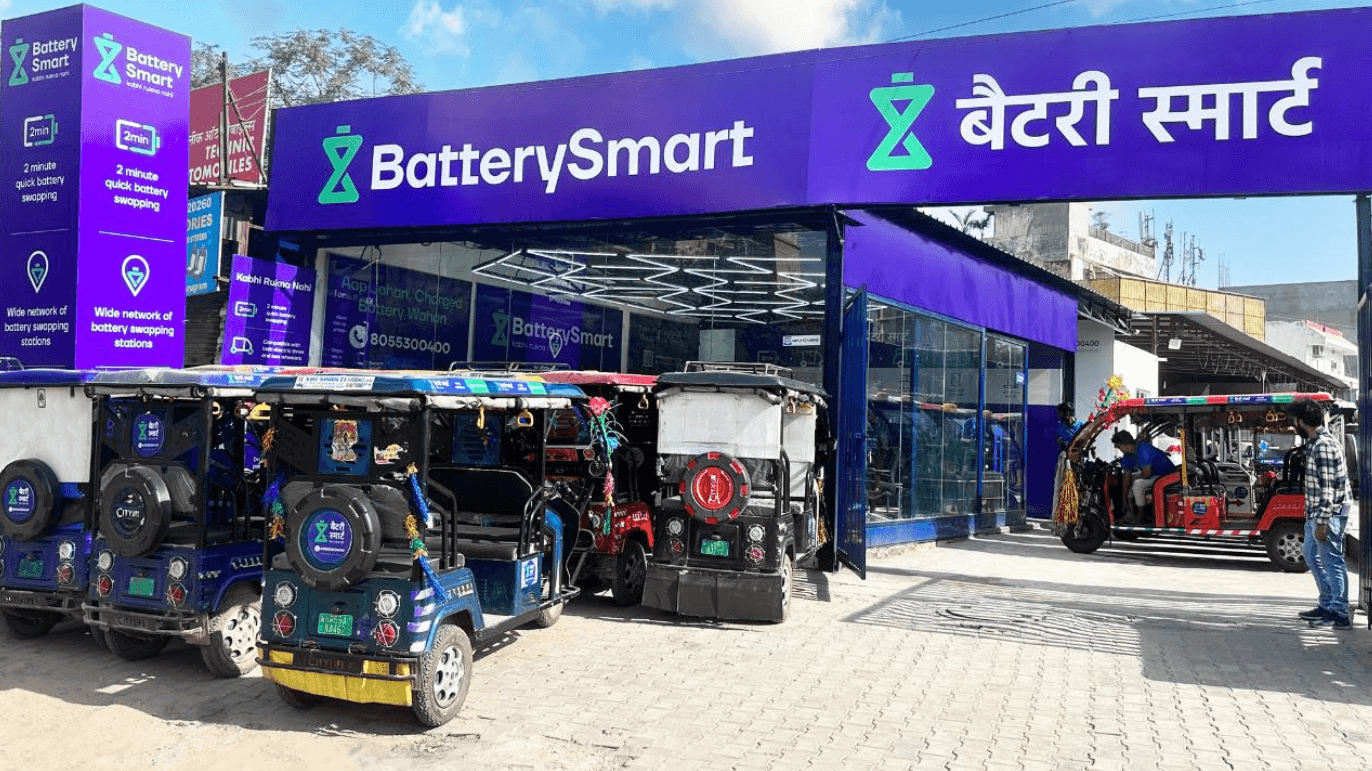
The company owns more than 3 lakh lithium-ion batteries and runs over 1,500 swapping stations in more than 75 cities, serving nearly 1 lakh commercial EV drivers. It has also reportedly reached operational break-even in FY26. But operational break-even is not the same as profit, positive cash flow, or a proven battery-replacement model.
How the business works
Battery Smart sells battery-as-a-service for electric two- and three-wheelers. Drivers swap an empty battery for a charged one instead of owning the battery.
Nearly 90% of its stations are run by franchise partners, who invest in the station infrastructure. Battery Smart provides the batteries, technology, and operating systems, and keeps ownership of the batteries.
So franchisees fund much of the station network, while Battery Smart holds the most expensive asset, the battery, which loses value over time.
The battery is the unit that matters

A station only earns money if batteries are swapped often. Each battery has to bring in enough swap revenue over its life to cover:
- its purchase cost
- charging electricity
- wear and replacement
- interest on the money borrowed to buy it
- depreciation
- station operations, technology and overheads
A battery that is rarely used is a slowly depreciating asset sitting in a station. A battery that is used too hard may wear out sooner. The key figures are how many swaps each battery completes, at what price, and over how many cycles.
What the numbers show
| Metric | Reported figure |
| FY24 operating revenue | ₹164 crore |
| FY25 operating revenue | ₹249 crore (up 52%) |
| FY25 total revenue / costs | ₹279 crore / ₹306 crore |
| FY25 EBITDA | Loss of ₹56 crore |
| FY26 revenue | ₹358 crore (up 43.8%) |
| Loss | ₹27 crore in FY25, ₹23.55 crore in FY26 |
Revenue is growing fast, and losses are small compared with it. But the headline loss hides what sits underneath. In FY24, depreciation rose to ₹85 crore and finance costs to ₹45 crore, against ₹164 crore of operating revenue. Those are the costs of owning batteries.
This is why “operational break-even” needs careful reading. In FY25, the company reported an EBITDA loss and later said it had turned EBITDA positive. EBITDA leaves out depreciation and interest, which are exactly the costs of owning batteries. A company can be EBITDA-positive and still not earn back its batteries.
A simple way to test it
The battery cost and cycle counts below are assumed for illustration. They are not company figures.
Suppose a battery costs ₹40,000 and lasts 1,500 swap cycles. It must earn about ₹27 per cycle just to repay its cost, before electricity, interest, or station costs. If it lasts only 1,000 cycles, that rises to ₹40 per cycle.
Now a rough check on what the network earns per battery. FY26 revenue was ₹358 crore, and the company owns more than 3 lakh batteries. Spread evenly, that is about ₹33 per battery per day. At that rate, a ₹40,000 battery would take about 3.3 years to earn back its cost in revenue alone, before any expenses.
This is a rough estimate, not a company-reported number. Revenue is not earned evenly across batteries, and the 3 lakh figure is today’s count, not an FY26 average. But it shows why utilisation, battery life and battery cost matter more than station count.
The growth target raises the stakes
Battery Smart is targeting 70–80% annual growth over the next three to five years, mainly through deeper presence in existing cities and expansion into new ones. More growth means more batteries and more working capital. The company has raised over $211 million so far, including a ₹185.5 crore Series C round this August.
The difference between the two kinds of growth is important. Growth from putting more batteries into the network raises capital needs. Growth from getting more swaps out of existing batteries improves the economics. The IPO papers should show which one is driving the numbers.
Franchisees have to earn too
Because franchisees put money into stations, they will only expand if their returns are good. If swap prices fall to attract drivers, franchisee margins can suffer. If prices rise, drivers may stay away. If battery costs go up, Battery Smart’s own economics get worse. The company has to balance three groups: drivers who want low prices, franchisees who need returns, and Battery Smart, which needs to recover battery costs and earn for shareholders.
What other swapping companies show
Gogoro (Taiwan). The scooter and swappable-battery company agreed to list on Nasdaq through a SPAC merger that valued it at $2.35 billion (enterprise value) and began trading on 5 April 2022. Its stock later fell below Nasdaq’s $1 minimum bid price for 30 consecutive business days, triggering a compliance notice. A listing, in other words, does not guarantee lasting investor confidence.
NIO (China). Swapping is expensive to build. NIO says it has invested over 20 billion yuan in charging and swapping technology. Its first-generation stations cost about 3 million yuan each, second-generation about 2 million yuan, and later generations about 1.5 million yuan. Gasgoo calls swapping typical heavy infrastructure with high annual maintenance costs.
NIO is now sharing the burden. It has partnered with over 40 local state-owned platforms and financial institutions to bring more than 800 swap stations into operation, with the partners holding the assets and NIO running them. Gasgoo notes that this helps ease NIO’s capital burden, but long-term success depends on operational efficiency. Battery Smart already uses franchise partners for stations, but it still owns the batteries.
Indofast and SUN Mobility (India). Indofast Energy is a 50:50 joint venture of IndianOil and SUN Mobility. It crossed 1,600 swap stations in 23 cities and 90,000 vehicles by the end of FY26, and targets 3,500 stations by FY27. SUN Mobility has recently appointed separate CEOs for its technology and manufacturing business and for Indofast’s network operations.
Battery Smart may eventually face a similar question: is it mainly a battery operator, a technology company, or an energy-infrastructure platform?
What the DRHP must show
Investors should look for:
- swaps per battery per day, and revenue per swap
- battery cost, expected life in cycles, and replacement cost
- how fast batteries degrade
- how busy each station is
- how much franchisees earn
- what “operational break-even” means in the company’s own definition
- depreciation and interest costs
- cash-flow trajectory
- capital spent per new battery and per new station
The bottom line
Battery Smart has built a large swapping network, grown revenue and narrowed its reported losses. But the IPO question is more specific: can the company recover the full lifecycle cost of its batteries while generating attractive returns on the capital it deploys?
If battery utilisation, useful life and swap revenue support those returns, the model could scale into a durable energy-infrastructure business. If not, network expansion could continue to consume capital without producing sustainable cash flow. The DRHP should give investors a clearer basis for judging which trajectory the company is on.
Read More: Zetwerk IPO: Why the ₹25,600 Crore Valuation Hinges on One Question