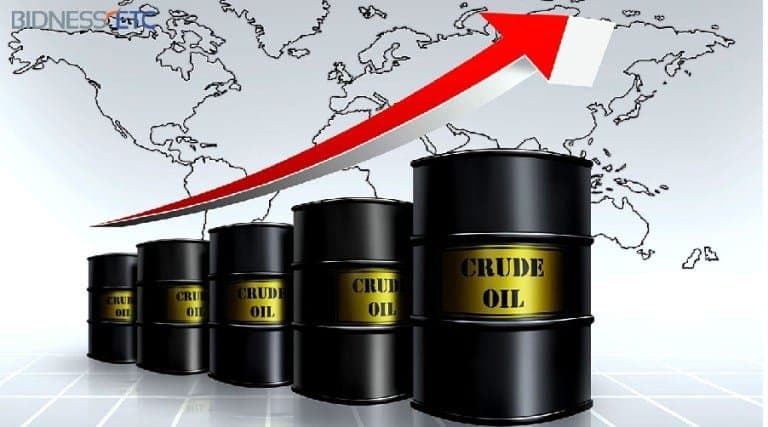
Global financial markets have entered a volatile new epoch as crude oil prices rapidly breached the $110 per barrel benchmark. Driven by escalating geopolitical conflict across the Middle East including fresh attacks in Saudi Arabia by Yemen’s Houthi rebels that prompted the United States to order non-essential diplomats to depart this severe petroleum surge has sent shockwaves through equity trading floors, currency desks, and central bank headquarters worldwide.
What initially appeared as localized geopolitical friction has rapidly metastasized into a systemic macroeconomic event, rekindling fears of persistent cost-push inflation and economic stagnation.
As Brent crude oil climbed past $110.60 per barrel, a broad-based energy shock swept through global financial markets, forcing institutional investors and corporate leadership to reassess baseline growth forecasts.
Economists warning that this sudden energy shock threatens to derail post-pandemic recovery efforts note that energy prices act as a direct tax on both enterprise operating margins and household disposable income. As central banks evaluate their next monetary steps, the global economic narrative has shifted decisively from managing a soft landing to mitigating severe commodity-driven headwinds.
Transmission Channels: The Anatomy of a Geopolitical Commodity Surge
The mechanism through which crude oil prices influence the wider economy is both swift and multifaceted. When petroleum costs surge past critical psychological thresholds like $110 per barrel, the immediate casualty of any major energy shock is consumer purchasing power.
Fuel costs do not remain isolated within the energy sector; they cascade rapidly into transportation, logistics, agricultural production, and industrial manufacturing.
The primary economic transmission vectors include:
- Direct Transportation and Logistics Overhead: Commercial freight networks, airlines, and maritime shippers face immediate operating cost spikes. These elevated costs are passed down to end consumers through fuel surcharges and higher retail shelf prices.
- Secondary Input Inflation for Manufacturing: Energy serves as a fundamental input for industrial manufacturing, synthetic materials, and agriculture. Consequently, elevated fuel prices lift headline inflation rapidly, while secondary impacts reach core inflation as firms adjust production charges.
- Household Consumption Squeeze: As utility bills, gasoline expenses, and food prices absorb a larger share of disposable income, consumer sentiment weakens and non-essential retail spending contracts.
- Currency and Trade Imbalances: For energy-dependent developing nations, a severe energy shock triggers immediate currency pressure as foreign exchange reserves are drained to finance expanded crude import bills.
The geographical distribution of these pressures is inherently uneven. Net energy exporters stand to gain substantial fiscal revenues and trade surpluses, providing a natural cushion against broader macroeconomic instability. Conversely, net energy importers across Europe and Asia bear the brunt of the burden.

For developing Asian economies that import the vast majority of their daily petroleum consumption, navigating the macroeconomic ripples of an energy shock requires tracking import bills, sovereign debt levels, and trade balance deterioration.
Central Banking Dilemmas: Monetary Policy in a High-Commodity Era
For global central banks, the sudden price surge presents an acute policy dilemma. Monetary policy authorities now face an acute dilemma caused by the energy shock, as sticky cost-push inflation directly conflicts with slowing economic growth momentum.
Prior to this geopolitical disruption, central bankers were largely evaluating rate-cut cycles to support normalizing economic activity. However, commodity price surges fundamentally alter the inflation outlook:
- The Risk of Premature Monetary Easing: Proceeding with rate cuts while energy prices are elevated risks unanchoring inflation expectations, allowing temporary energy spikes to embed themselves into permanent core inflation and wage-price spirals.
- The Threat of Over-Tightening: Maintaining restrictive interest rates to suppress demand risks triggering outright economic recessions, particularly in nations already contending with high debt loads and fragile business confidence.
- Divergent Global Policy Actions: Economies with strong fiscal buffers and deeper capital markets can absorb volatility more effectively, whereas vulnerable nations may be forced into defensive rate hikes to prevent currency capital flight.
Market participants must recognize that a sustained energy shock narrows the window for central bank rate cuts, shifting terminal rate projections higher and steepening yield curves across major bond markets. Financial conditions are consequently tightening, raising borrowing costs for corporations, mortgage holders, and national governments alike.
Equity Market Vulnerabilities and Corporate Sectoral Impact
Stock markets across the globe have reacted with immediate distress to elevated energy prices. On Dalal Street, where the Indian Sensex plummeted over 600 points (declining 0.5% to 73,343.3) and the Nifty 50 fell 0.54% to 22,687.75, the domestic impact of the energy shock was swift, dragging down major benchmark indices in early trading hours.
Market weakness was broad-based, with 15 of the 16 major sectoral indices trading lower, while broader mid-cap and small-cap indices dropped 1.3% each.
A granular examination of corporate earnings filings and market movements highlights clear areas of vulnerability and strategic resilience:
- Quick-Commerce and Consumer Logistics: Quick-commerce operators face margin compression due to expanding delivery footprints and rising fuel expenses. For instance, Eternal reported quarterly revenue above estimates, but its net profit missed expectations amid higher expenditure on expanding its quick-commerce unit, Blinkit. However, leadership expects Blinkit to accelerate growth from the December quarter as competitive conditions stabilize.
- Auto Finance and Consumer Lending: Non-banking financial companies show mixed operational trends. Mahindra & Mahindra Financial Services reported higher revenue and profit for the July–September quarter, supported by strong disbursements growth despite broader macro uncertainty.
- Defense and Strategic Electronics: State-backed defense equipment suppliers exhibit strong revenue visibility insulated from consumer cycles. Bharat Electronics secured fresh orders worth ₹1,011 crore shortly after previous disclosures, demonstrating resilient public sector capital expenditure.
- Primary Capital Market Demand: Capital market appetite for high-quality mega-issues remains remarkably intact. India’s largest public offering by Jio Platforms ($3.2 billion issue) was fully subscribed within hours of opening on Wednesday, driven by overwhelming institutional investor demand. Furthermore, foreign institutional investors (FIIs) remained net buyers of Indian equities worth ₹1,022 crore, while the Indian rupee held steady at 94.46 against the US dollar.
Even as the energy shock battered consumer-facing equities and heightened short-term market volatility, institutional liquidity continues to selectively back companies with strong balance sheets, pricing power, and long-term order visibility.
Analytical Framework and Forward-Looking Scenarios
To understand where global markets are headed, policymakers and institutional asset managers must evaluate potential trajectories of the ongoing energy shock:
- Scenario A: Transitory Geopolitical Friction: Under a transitory scenario, the initial energy shock proves short-lived as supply conditions stabilize and inflation expectations remain anchored. Central banks maintain temporary policy pauses before resuming gradual rate reductions, allowing equity valuations and business confidence to recover rapidly.
- Scenario B: Sustained Structural High-Cost Regime: Conversely, if the energy shock persists across multiple quarters, elevated operating costs will drive entrenched core inflation and force central banks to maintain restrictive interest rates. Under this scenario, corporate profit margins face severe compression, borrowing costs remain high, and economic growth decelerates sharply across net energy-importing regions.
- Scenario C: Fragmented and Uneven Regional Adjustment: A third trajectory involves stark divergence, where net commodity exporters and well-buffered economies adapt smoothly, while heavily indebted energy importers face prolonged stagflationary pressures and currency depreciation.
Surviving a multi-quarter energy shock demands proactive risk management, operational agility, and disciplined capital allocation from enterprise leadership. Corporations must actively review working-capital needs, evaluate supplier concentration, implement commodity hedging, and manage debt maturity schedules to insulate themselves against persistent macro volatility.
Analytical Conclusion: Navigating Structural Macroeconomic Shifts
Ultimately, managing through this severe energy shock requires a disciplined framework that weighs immediate price volatility against long-term structural shifts. Rather than reacting impulsively to single-session trading movements, institutional market participants must track confirmation across multiple macroeconomic indicators.
Key focal points for the upcoming quarters include:
- Tracking Core CPI and Wage Dynamics: Monitoring whether elevated transport and energy costs spill over into broader core services inflation and wage demands.
- Central Bank Communication and Rate Guidance: Analyzing official statements from the Federal Reserve, ECB, and RBI for shifts in terminal rate projections or policy timelines.
- Sovereign Bond Yields and Currency Movements: Evaluating foreign exchange pressures and government borrowing costs, particularly in energy-importing emerging markets.
- Corporate Margin Trends and Capital Expenditure: Assessing purchasing managers’ index (PMI) surveys and quarterly corporate disclosures to identify which sectors successfully maintain pricing power.
By maintaining a rigorous, data-driven approach, investors and corporate leaders can navigate commodity-driven turbulence and position themselves strategically for the next phase of the global economic cycle.
Also Read:The AI Implementation Gap: Why Technology Spending Doesn’t Guarantee Productivity