Indian equities reverse early gains as foreign investor selling, geopolitical uncertainty and rising borrowing costs weigh on market sentiment
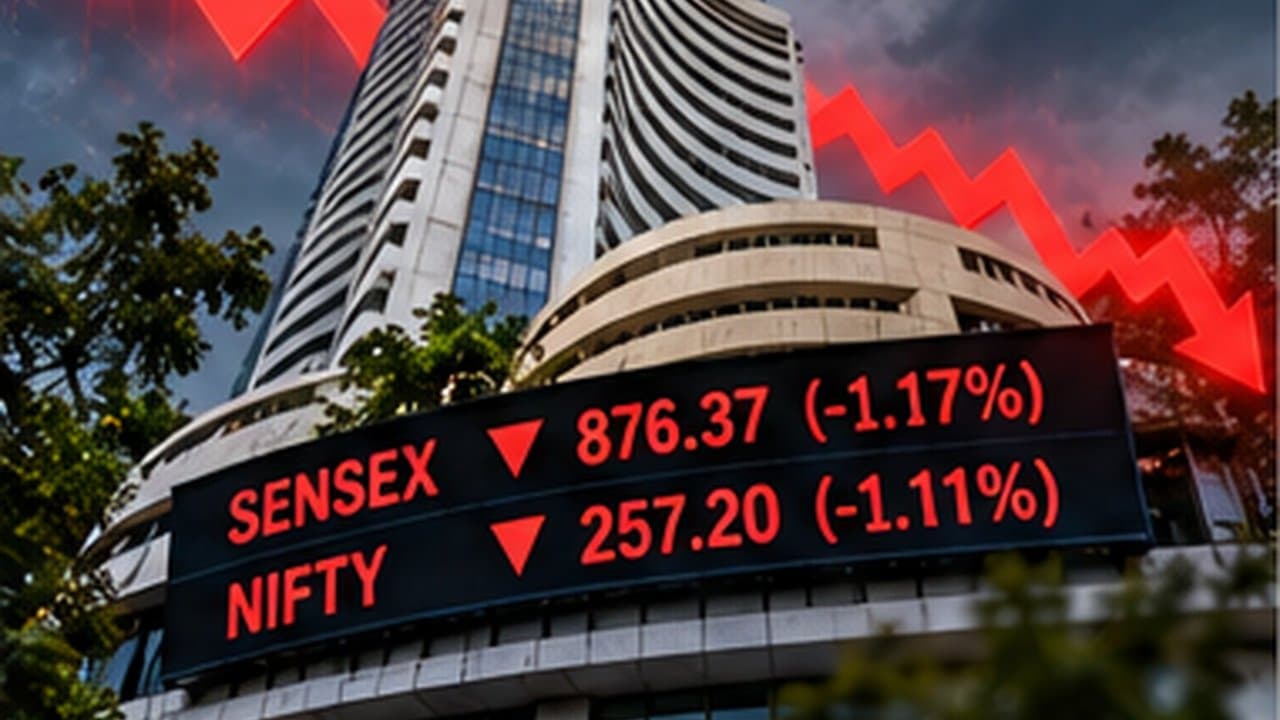
Indian stock markets came under renewed selling pressure on Monday, October 12, with the benchmark Sensex falling 547.65 points, or 0.76%, to close at 71,924.68. The Nifty 50 declined 157.10 points, or 0.70%, to settle at 22,363.35.

Both indices opened higher but reversed direction during the session, with the Sensex losing nearly 1,000 points from its intraday high, according to market reports. The decline reflected investor concerns over elevated crude oil prices, rising government bond yields, persistent foreign fund outflows and geopolitical uncertainty.
The session highlighted the fragility of market sentiment as investors weighed domestic inflation risks against uncertainty in global markets.
Five factors behind the market decline and Sensex fall
1. Rising crude oil prices
International crude oil prices remained a major concern for investors, with Brent crude reported around $106 a barrel amid escalating tensions in the Middle East.
India imports a substantial share of its crude oil requirements. Higher prices can increase the country’s import bill, put pressure on the rupee and raise costs for fuel-intensive industries, including aviation, transportation, chemicals and paints.

More expensive energy can also feed into inflation by increasing logistics and production costs. That could complicate the Reserve Bank of India’s efforts to bring inflation back towards its medium-term target.
2. Foreign investor selling
Persistent selling by foreign institutional investors has added to pressure on Indian equities. According to The Economic Times, foreign investors sold Indian equities worth approximately ₹45,125 crore during the first six trading sessions of October.
Sustained outflows can weigh on benchmark indices and put pressure on the rupee, particularly when investors find other markets more attractive or reduce exposure to riskier assets.
However, foreign investor selling is only one part of the market equation. Domestic institutional investors, company earnings, valuations and broader economic conditions also influence the direction of Indian equities.
3. Government bond yields climb
Rising bond yields have emerged as another source of concern. The benchmark 10-year government bond yield was reported at 7.39% on October 12, its highest level since March 2023.
Higher yields can make bonds more attractive relative to equities, potentially encouraging some investors to rebalance their portfolios. They can also increase borrowing costs for companies and the government.

For equity markets, the effect can be particularly significant for businesses whose valuations depend heavily on expectations of future earnings, because higher interest rates reduce the present value of those future cash flows.
ALSO READ: Sensex recovery: Indian stock market rebounds as Nifty rises after 18-month low
4. Geopolitical uncertainty and global cues
Escalating tensions in the Middle East have added uncertainty to the global economic outlook. Investors are concerned about the potential impact on energy supplies, shipping routes, inflation and international trade.
Weak cues from other Asian markets also contributed to the cautious mood on Dalal Street.
The extent of the market impact will depend on whether geopolitical tensions disrupt actual energy supplies or remain primarily a source of uncertainty. A sustained rise in oil prices would have more direct consequences for India’s inflation and current account than a temporary price spike.
5. Profit-booking after early gains
The market’s reversal from early gains also indicates that investors were unwilling to sustain buying in the face of persistent macroeconomic risks. The Sensex opened higher before giving up its gains, while the Nifty ended below the psychologically important 22,400 level.
Profit-booking may have contributed to the decline, although the available market reports identify several overlapping pressures rather than a single cause.
Which stocks and sectors were affected?
Information technology, fast-moving consumer goods and public-sector banking stocks were among the weaker segments of the market. ITC and Tech Mahindra fell more than 3%, while Hindustan Unilever, Larsen & Toubro and State Bank of India also featured among the reported laggards.
The performance was not uniformly negative. Defence major Bharat Electronics, Mahindra & Mahindra, Kotak Mahindra Bank, HCL Technologies and Bajaj Finance were among the reported gainers. The Nifty Smallcap 100 also advanced, highlighting the mixed performance beneath the headline indices.
This divergence suggests that the session was not simply a broad-based retreat from all equities. Sector-specific factors and individual company developments continued to influence stock performance.
What should investors watch next?
Investors will be watching several developments over the coming sessions:
- Crude oil: Whether Brent prices remain elevated or ease as geopolitical developments unfold.
- Foreign investor flows: Whether overseas selling slows and domestic buying provides support.
- Inflation and interest rates: Whether rising consumer prices increase expectations of further RBI tightening.
- Corporate earnings: Whether quarterly results and management guidance justify current valuations.
- Bond yields and the rupee: Whether borrowing costs and currency movements add to pressure on equities.
The latest inflation data, released on October 12, showed retail inflation rising to 5.54% in September from 4.83% in August, while food inflation climbed to 7.74%. These figures add another variable for investors assessing the interest-rate outlook.