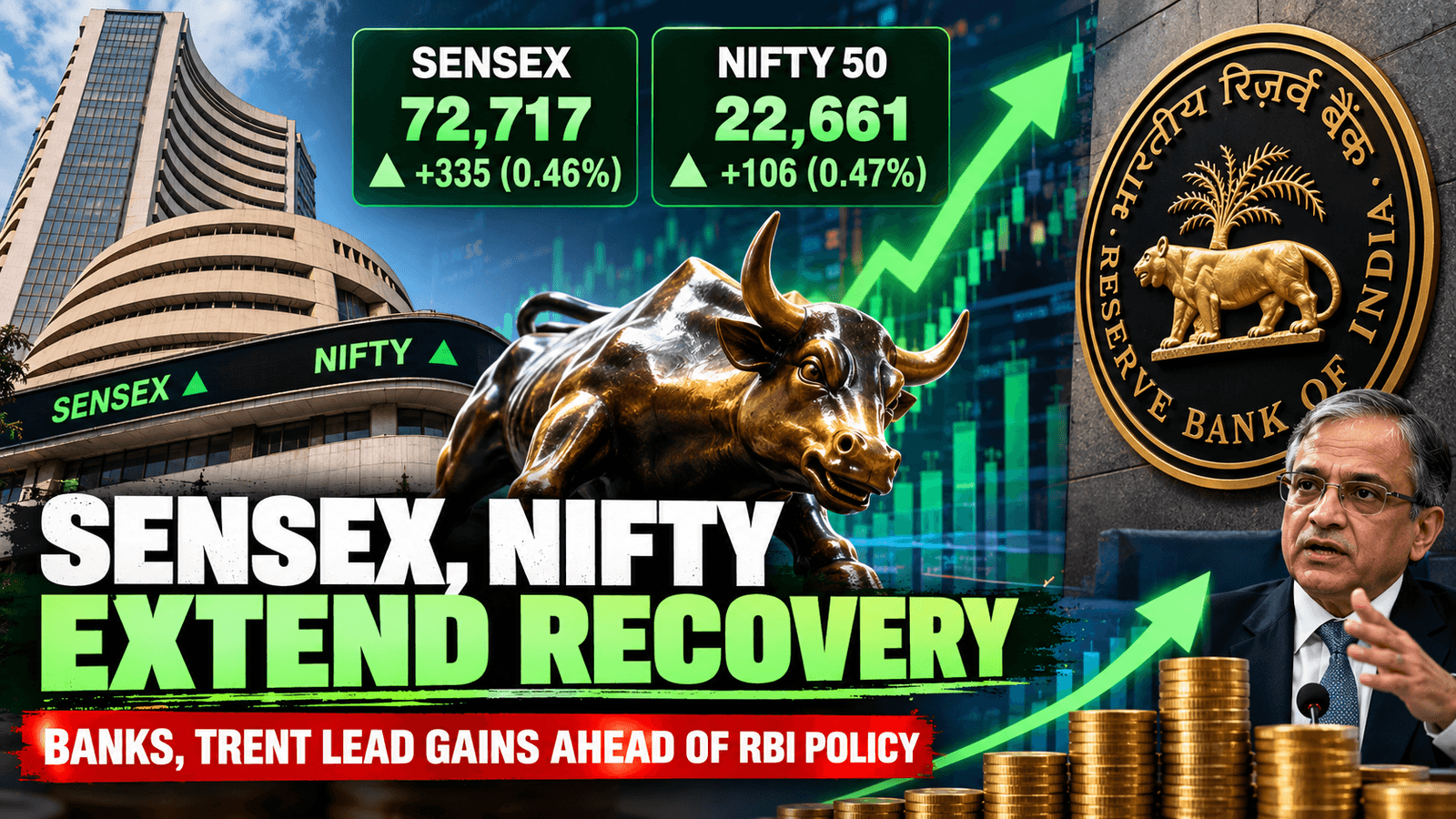
The Indian stock market continued its recovery on Tuesday, October 6, with the Sensex and Nifty 50 trading higher as investors remained focused on quarterly business updates and the Reserve Bank of India’s upcoming monetary-policy decision.
At around 9:52 AM IST, the Nifty 50 was up 0.35% at 22,635.70, while the BSE Sensex gained 0.34% to 72,630.42. The gains followed a stronger session on Monday, when both benchmark indices advanced around 0.6%.
The recovery for the Indian stock market comes after Indian equities endured an extended period of weakness, with the benchmarks recently recording their longest weekly losing streak in roughly 25 years.
Why are Sensex and Nifty rising today?
Several factors are supporting investor sentiment.
The first is positive quarterly business updates from major companies, which have triggered stock-specific buying.

The second is a relatively supportive global market environment. US equities ended higher in the previous session, while Asian markets were largely positive.
Investors are also taking some comfort from easing expectations of aggressive US monetary tightening following softer US employment data.
However, gains remain limited because crude oil prices are still elevated and US Treasury yields have risen sharply.
Banks lead the Indian stock market recovery
Banking and financial stocks were among the strongest performers during Tuesday’s session.
Kotak Mahindra Bank rose sharply after reporting an increase in quarterly advances and deposits, while Axis Bank also gained following its quarterly update.

Reuters reported that Kotak Mahindra Bank was up around 3.8%, while Axis Bank gained around 1.4% during morning trade.
Financials are particularly important for the broader market because the banking sector has a significant weight in benchmark indices.
Investors are also watching how a potential RBI rate hike could affect banks’ margins, credit growth and deposit costs.
Trent shares jump around 10%
One of the biggest stories in Indian stock market on Tuesday was Trent, which surged approximately 10% following a strong September-quarter business update.
The Tata Group retailer projected standalone revenue growth of around 23% year-on-year for the quarter.
The strong update triggered significant buying interest and made Trent one of the biggest gainers among major Indian stocks.
Other companies also attracted attention after releasing quarterly updates, including Godrej Consumer Products.
Nifty IT remains under pressure
The recovery for the Indian stock market was not broad-based across every sector.
The Nifty IT index remained under pressure, with the index down around 0.8% during morning trade, according to market data.
The weakness comes as investors assess global technology spending, US demand and the impact of artificial intelligence on the traditional IT-services business model.
The upcoming TCS quarterly results will therefore be closely watched by investors.
RBI policy decision is the biggest trigger
The biggest Indian stock market event this week is the RBI Monetary Policy Committee decision on October 7.
Market expectations have increasingly centred on a 25-basis-point rate hike, which would be the first RBI rate increase since February 2023.
The current repo rate is 5.25%.
Investors will be watching not just the rate decision but also RBI Governor Sanjay Malhotra’s comments on:
- Inflation
- Economic growth
- Crude oil risks
- Liquidity
- The rupee
- Future interest-rate policy
A 25-basis-point hike is increasingly seen as being priced into the market, meaning the RBI’s guidance could be more important than the rate decision itself.
Foreign investors remain a concern
Despite the Indian stock market recovery, foreign investor selling continues to weigh on sentiment.
Foreign Portfolio Investors sold approximately ₹4,699 crore worth of Indian equities on Monday, while domestic institutional investors bought around ₹5,182 crore.
This divergence has become an important feature of the Indian market.
Domestic institutions are providing support through continued buying, but persistent foreign selling can limit the upside in large-cap stocks.
Crude oil remains a key risk
Oil prices are another major factor for Indian markets.
Brent crude was trading around $100–101 per barrel on Tuesday.
While prices have eased from recent highs following increased Middle Eastern exports and efforts by G7 countries to boost supplies, crude remains elevated for an oil-importing economy such as India.
Higher oil prices can put pressure on India’s inflation, current account and currency.
ALSO READ: PSU Bank shares slid amid global concerns, leading to stock market under pressure
US bond yields add another layer of uncertainty
Another concern is the sharp rise in US Treasury yields.
The 10-year and 30-year US Treasury yields recently reached their highest levels in about 24 years amid renewed inflation concerns.
Higher US yields can encourage global investors to move money towards dollar-denominated assets, potentially increasing pressure on emerging-market currencies and equities.
What should investors watch next?
For Indian investors, the immediate market triggers are clear:
First: RBI’s monetary-policy decision on October 7.
Second: Continued FII and DII flows.
Third: Crude oil prices.
Fourth: The rupee-dollar exchange rate.
Fifth: Corporate earnings, particularly TCS and other major companies.
The market’s recent recovery is encouraging, but analysts remain cautious because several macroeconomic risks have not disappeared.