Flipkart is expanding into quick commerce and food delivery while continuing to operate its core marketplace and fashion platform Myntra. The strategy could create a wider commerce ecosystem—but the data also shows that these businesses have different customers, operating models, and economics.
The important question is not whether Flipkart is entering too many categories. It is whether these categories are creating measurable advantages for one another.
Flipkart’s four businesses
Flipkart’s current consumer-facing structure includes:
- Flipkart: general online retail and marketplace commerce.
- Myntra: fashion and lifestyle e-commerce.
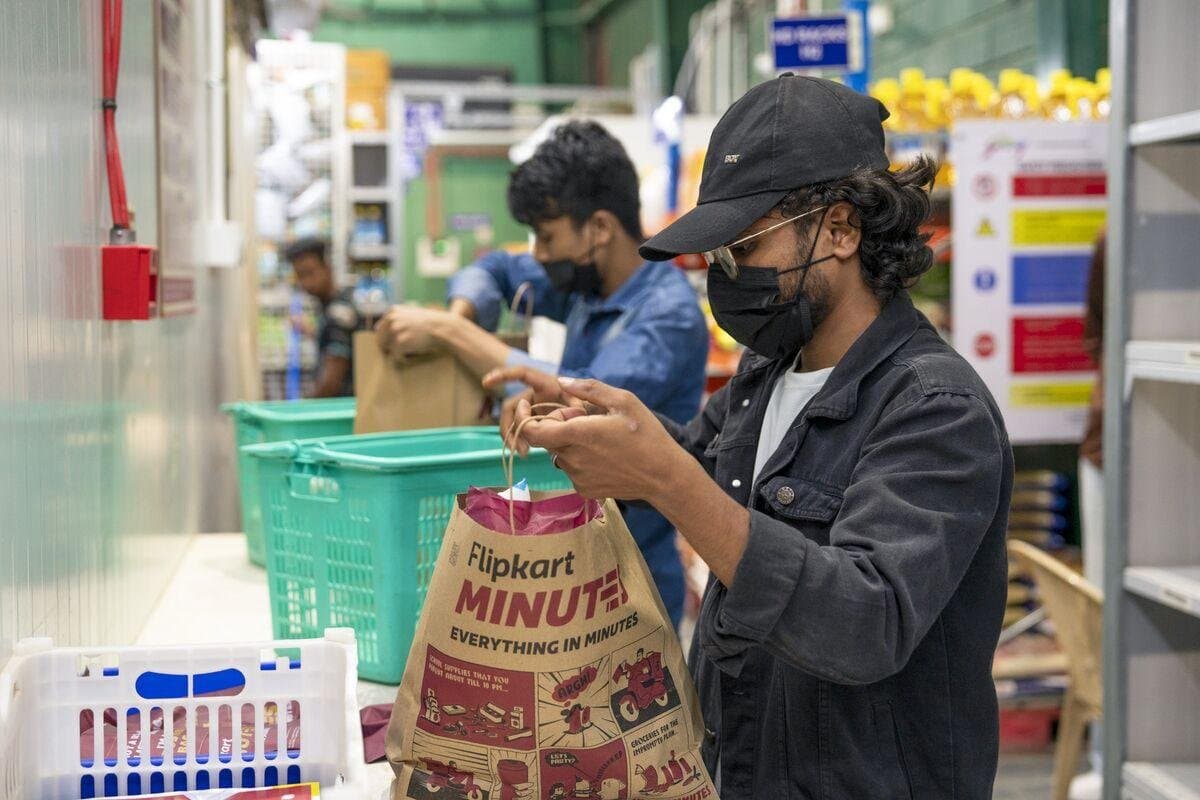
- Flipkart Minutes: quick commerce and micro-fulfilment.
- Eat In: a food-delivery pilot.
The company is not reporting standalone financial results for all these businesses. Therefore, the strategy has to be evaluated through operating data such as store growth, order growth, customer retention, revenue, profitability, and merchant acquisition.
Minutes is scaling quickly
Flipkart launched Minutes in August 2024. By September 2026, the platform reported:
- Fourfold year-on-year growth.
- Nearly 1,200 micro-fulfilment centres.
- Presence in more than 150 cities.
- Nearly fivefold year-on-year growth in its Gen Z customer base.
- Nearly 25-fold year-on-year growth in its Tier-2-plus customer base.
- Around 60% of customers returning to shop on Minutes.
These figures were reported in Flipkart’s official anniversary communication and by Economic Times Retail.
Flipkart also said that Minutes had crossed 1,000 micro-fulfilment centres across more than 130 cities and 8,000 PIN codes by June 2026. The company’s official network update reported this expansion.
The 60% repeat-shopping figure is strategically more useful than the fourfold growth figure. Growth shows that the business is expanding; repeat usage indicates whether it is becoming a habit.
However, Flipkart has not publicly disclosed standalone Minutes revenue, contribution margin or adjusted EBITDA. Its growth cannot therefore be directly compared with Blinkit, Zepto or Instamart using a common profitability table.
Why create a separate app?
Flipkart launched a standalone Minutes app in pilot mode with selected users in Bengaluru. The Economic Times reported that the app was being tested ahead of the Big Billion Days sale. The app is now available to all users on the Play Store and App Store to download.
The separate app matters because quick commerce requires a different customer experience from general e-commerce. Its key operating variables are:
- Delivery time.
- Local inventory.
- Micro-fulfilment-centre coverage.
- Product availability.
- Order frequency.
- Store-level order density.
A general Flipkart marketplace is designed for a much wider catalogue and planned purchases. Minutes is designed for immediate needs and frequent orders.
The separate app is therefore not proof that Flipkart’s ecosystem has failed. It may indicate that quick commerce requires a specialist interface and operating model.
But the app also creates a measurement problem. Flipkart will need to show whether the separate application increases order frequency and retention or merely shifts existing customers from one Flipkart interface to another.
What Minutes sells
Minutes is moving beyond grocery.
Flipkart’s official announcement says the platform has expanded into electronics, beauty, wellness and more than 120 categories.

Electronics are particularly important because they can raise average order value. Financial Express reported that mobile-phone sales helped lift Minutes’ overall order value. The report said that, excluding mobile-phone purchases, Minutes’ average order value was approximately ₹500–530 (UBS estimate).
This creates a possible advantage over grocery-only quick commerce. Larger orders can improve revenue per delivery, although higher-value products may also involve more working capital, inventory risk and returns.
Eat In remains an experiment
Flipkart is also testing food delivery through Eat In.
The company first piloted the service with employees in Bengaluru. Business Standard reported that the pilot was being used to test the model before a broader rollout.
Flipkart was reportedly in discussions with approximately 300 Bengaluru restaurants for the initial pilot. The Financial Express reported that the proposed commission and advertising charges could be capped at 15–20% of order value, with earlier reports putting the commission at 10–11%.
These are proposed pilot terms, not confirmed nationwide rates.
Eat In’s early structure is important because it suggests that Flipkart is trying to differentiate itself on merchant economics. Zomato and Swiggy have much larger restaurant networks, but restaurants often complain about commissions and advertising costs.
A lower commission could help Flipkart acquire restaurants. It would also reduce revenue per order, which means the company would need to compensate through:
- Higher order volume.
- Better delivery utilisation.
- Lower customer-acquisition costs.
- Advertising revenue.
- More efficient technology and logistics.
At present, Eat In is still a pilot. There is no public data showing its order volume, restaurant retention, customer repeat rate, or contribution margin.
Myntra is already a profitable asset
Myntra is different from Minutes and Eat In because it is an established business rather than a new pilot.
Myntra’s FY25 operating revenue rose 18% to ₹6,042.7 crore from ₹5,121.8 crore in FY24. Its net profit increased to ₹548 crore from approximately ₹31 crore in FY24. Moneycontrol reported these figures from company filings.
The reported profit should be interpreted carefully. The Economic Times noted that the FY25 result included a deferred-tax credit of ₹135 crore.
Myntra also has a large user base. The company said it had more than 75 million monthly active users in April 2026. Myntra’s official seller-growth update made that claim.
Business Standard reported that Myntra controlled an estimated 35–40% of India’s organised online-fashion market and about 90% of its 75 million+ users received personalised search results.
Myntra’s data suggests that Flipkart already owns a profitable, high-frequency digital commerce asset. The strategic question is whether that asset can help Minutes and Eat In—or whether it simply operates as a separate business under the same parent company.
What can actually be shared?
Flipkart may be able to share some capabilities across its businesses:
- Customer accounts.
- Payments.
- Fraud prevention.
- Technology.
- Advertising tools.
- Data science.
- Customer support.
- Logistics capabilities.
- Brand and seller relationships.
But the operating systems remain different.
| Business | Core supply side | Customer need | Main operating challenge |
| Flipkart marketplace | Sellers and warehouses | Planned shopping | Selection, price and fulfilment |
| Myntra | Fashion brands and sellers | Discovery and purchase | Returns, personalisation and seasonality |
| Minutes | Micro-fulfilment centres | Immediate needs | Store density, inventory and delivery |
| Eat In | Restaurants and delivery partners | Prepared food | Restaurant density and delivery reliability |
This table shows why corporate ownership does not automatically create operating synergy.
Amazon’s comparison
Amazon is also investing heavily in quick commerce while operating a wider online retail ecosystem.
Amazon said it would expand Amazon Now to 100 Indian cities with more than 1,000 micro-fulfilment centres. The New Indian Express reported.
Amazon later expanded Amazon Now to more than 120 cities and targeted 300 cities by the end of 2026, according to CNBC-TV18.
Reuters reported that Amazon planned to invest $3 billion in Indian quick commerce by 2030.
Amazon’s example suggests that quick commerce may require a dedicated service even when the parent company already operates a large marketplace. The strategic similarity with Flipkart is clear: both companies are trying to connect general e-commerce with faster, more frequent purchases.
The difference is that Amazon has not entered food delivery in India in the same way that Flipkart is testing Eat In. That gives Flipkart an additional opportunity, but also another operating challenge.
Zomato and Swiggy offer a closer comparison
Zomato and Swiggy have expanded from food delivery into adjacent services.
Eternal operates Zomato, Blinkit, District and Hyperpure. Its Q1FY27 shareholders’ letter reported consolidated adjusted EBITDA of ₹555 crore and B2C NOV of ₹31,120 crore. Eternal’s official results show how the company is combining food delivery, quick commerce, going-out and restaurant supply.
Swiggy operates food delivery, Instamart and Dineout. At its 2026 Capital Markets Day, the company announced a FY31 target of ₹10,000 crore in adjusted EBITDA. Its targets included:
- ₹5,000 crore adjusted EBITDA from food delivery.
- Instamart GOV above ₹1.5 lakh crore.
- Dineout GOV of ₹20,000–25,000 crore.
- Dineout adjusted EBITDA of approximately ₹1,000 crore.
These are management targets, not achieved results. Swiggy’s official Capital Markets Day announcement provides the company’s stated strategy.
The comparison suggests that adjacency works best when businesses are connected by a common consumer habit. Food delivery, grocery delivery and dining-out services all involve frequent consumption and location-based fulfilment.
Flipkart’s challenge is that fashion, general e-commerce, quick commerce and food delivery are less naturally connected.
What Flipkart needs to prove
The strategy will be coherent if the company can show measurable benefits:
For Minutes
- Repeat customers remain above the reported 60% level.
- Micro-fulfilment centres generate sufficient order density.
- Average order value rises beyond basic grocery purchases.
- Contribution margins improve.
- Growth is not dependent entirely on discounts.
For Eat In
- Restaurant acquisition progresses beyond the reported 300-restaurant pilot.
- Lower commissions attract enough restaurants.
- Orders per restaurant become sustainable.
- Delivery costs remain controlled.
- Customers return without heavy subsidies.
For the group
- Customers use more than one Flipkart service.
- Shared technology lowers operating costs.
- Logistics assets are used more efficiently.
- Advertising revenue grows across businesses.
- New businesses move towards standalone profitability.
Conclusion
The available data does not support the idea that Flipkart is simply adding apps without a strategy. Minutes has achieved substantial scale, with fourfold year-on-year growth, nearly 1,200 micro-fulfilment centres and a presence in more than 150 cities. Myntra is already a large and profitable fashion platform. Eat In is a smaller and earlier-stage experiment.
At the same time, Flipkart has not disclosed enough business-level financial data to prove that these services are creating meaningful synergies. Minutes has no publicly disclosed standalone EBITDA figure, while Eat In has not yet reported customer or restaurant performance.
The most accurate description is that Flipkart is building a portfolio of digital-commerce businesses around different shopping frequencies:
- Myntra for fashion discovery.
- Flipkart for planned purchases.
- Minutes for immediate needs.
- Eat In for prepared food.
The strategy will work only if these businesses share more than a parent company. Flipkart must show that customers move between them, that infrastructure is reused efficiently and that each business can improve its economics without depending indefinitely on fresh investment.
For now, Flipkart is not exactly competing with itself. It is testing whether one company can own several parts of the consumer’s day.
Read More: When a Founder’s Personal Brand Becomes the Business