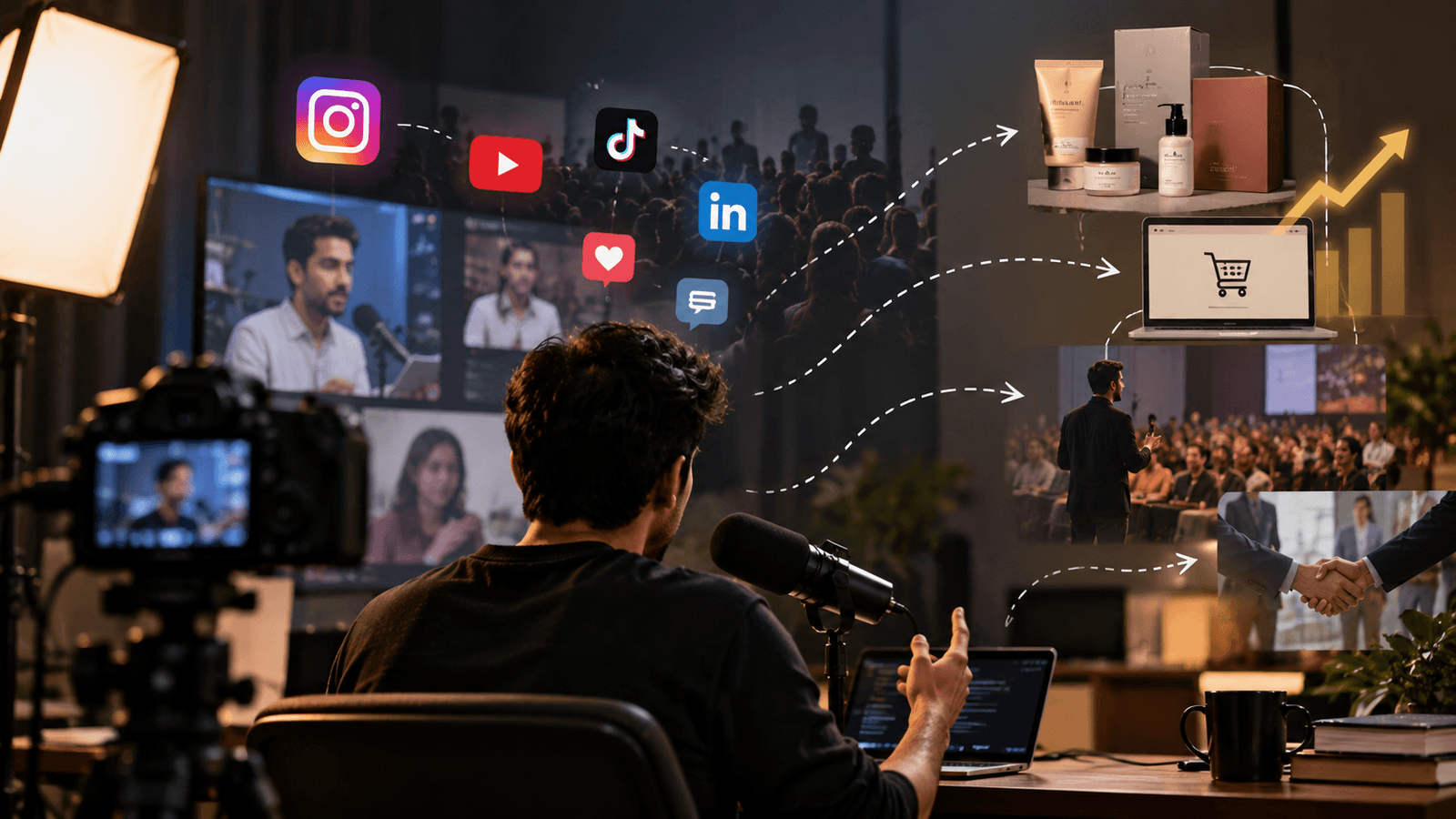
A founder’s personal brand can become one of a young company’s most powerful distribution channels. Founders are increasingly using podcasts, YouTube, and social media as distribution channels. A trusted audience can help them launch products, attract customers, and build partnerships before a company spends heavily on conventional advertising.
But an audience is not automatically a moat. The central question is whether customers remain loyal to the product and company—or only to the founder.
Recent research shows how common creator-led distribution has become. Economic Times Brand Equity reported that 75% of Indian D2C brands use creators to drive sales. The report said brands were moving beyond one-off influencer campaigns towards continuous creator-led storytelling, user-generated content and social proof.
Nikhil Kamath: Building a Founder’s Personal Brand Beyond an Audience
Nikhil Kamath is best known as the co-founder of Zerodha. His public profile expanded through WTF is with Nikhil Kamath, a podcast featuring entrepreneurs, experts and public figures across technology, finance, culture and business. The Economic Times reported that the podcast crossed 16 million YouTube views after its launch.
Kamath has also connected the WTF identity to founder support. His WTFund offers non-dilutive grants of up to ₹20 lakh, along with mentorship and ecosystem access, without taking equity. The official WTFund website describes the programme, while The Financial Express reported that it was created for entrepreneurs aged 25 and below.
This is more than a podcast monetised through sponsorships. It is an ecosystem in which media creates attention, the fund creates founder relationships, and the WTF identity becomes associated with entrepreneurship and access to capital.
This structure is more durable than attaching a founder’s personal brand to a single consumer product. However, it remains dependent on Kamath’s credibility and continued involvement.
Ranveer Allahbadia: turning content into infrastructure

Ranveer Allahbadia, known as BeerBiceps, began with fitness and lifestyle content before expanding into podcasts and creator-focused businesses.
His official website identifies him as the creator of BeerBiceps, founder of Monk Entertainment, and host of The Ranveer Show. BeerBiceps’ official profile provides this background.
Monk Entertainment was founded by Viraj Sheth and Allahbadia as a talent-management, influencer-marketing, and content-production company. Storyboard18 reported on its role in India’s creator economy.
The important shift is from personality to infrastructure:
Audience→Content→Creator services→Business relationships
The model becomes stronger when the company can manage creators, produce content, and serve clients beyond the founder’s own channel. It remains vulnerable if customers and creators are loyal primarily to Allahbadia rather than to Monk Entertainment itself.
What creator-led D2C brands reveal
Creator-led D2C brands use an existing audience to introduce products in categories such as beauty, fashion, fitness, food and wellness. Inc42 reported on Indian creators and influencers launching social-first consumer brands.
This gives creators an advantage over unknown startups: they can test demand before committing large amounts to advertising.
But personal reach does not solve the operational problems of consumer businesses. The company still needs:
- A product that works.
- Reliable manufacturing and supply.
- Fulfilment and customer service.
- Pricing discipline.
- Repeat demand.
- Distribution beyond the founder’s page.
The creator may reduce the cost of the first sale. The product must still create the second sale.
Founder’s Personal Brand: Moat or key-person risk?
A personal brand becomes a moat when it creates capabilities that competitors cannot easily reproduce. These may include trust, community, product feedback, partnerships, and efficient access to a specific audience.
But the moat is not the follower count. It is the company’s ability to convert attention into assets it owns:
- Repeat customers.
- Direct customer data.
- Product loyalty.
- Independent brand recognition.
- Multiple acquisition channels.
- A team that can communicate without the founder.
This creates a useful distinction.
A founder-led company uses the founder’s reputation to accelerate growth and then builds a broader organisation around it.
A founder-dependent company relies on the founder for most traffic, credibility, media attention, and partnerships.
The difference can be tested by asking what happens if the founder stops posting for six months. A durable company should still have direct traffic, repeat purchases, independent brand recall, a functioning marketing team, and customers who search for the product by name.
If traffic and sales fall sharply, the company may have built an audience but not a brand.
The reputational trade-off
Personal-brand businesses also concentrate reputational risk.
A controversy involving the founder can affect customers, brand partners, employees, investors, and advertisers at the same time. Traditional companies can replace a spokesperson; a company built around a founder cannot separate itself so easily from the person who created it.
This risk is greater when the founder:
- Makes product or health claims.
- Promotes financial products or investments.
- Is the face of every advertisement.
- Controls all major communication.
- Has no independent leadership or content team.
The reputational risk of a founder’s personal brand is that the same trust that accelerates customer acquisition can amplify the damage when that trust is lost.
What Investors Should Measure in a Founder’s Personal Brand
Follower counts are only a starting point. Investors should examine:
| Metric | What it reveals |
| Direct and branded traffic | Whether customers remember the company, not only the founder |
| Repeat-purchase rate | Whether the product creates value beyond initial trust |
| Sales from non-founder content | Whether the brand can scale beyond one voice |
| Customer data owned by the company | Whether the business depends entirely on social platforms |
| Revenue concentration | How much the business depends on one founder or channel |
| Customer-acquisition cost | The financial value of founder-led distribution |
| Contribution margin | Whether sales remain profitable after marketing and fulfilment |
| Sales during founder inactivity | Whether demand survives without constant promotion |
Conclusion
A founder’s personal brand can be an efficient route to early customers. It creates attention, trust and distribution before a company has the resources to build them through traditional advertising.
But the personal brand is only a durable moat if the company can convert attention into product loyalty, repeat purchases, customer data, and independent brand recognition.
Nikhil Kamath’s WTF ecosystem shows how media can develop into founder support and startup networks. Ranveer Allahbadia’s BeerBiceps ecosystem shows how content can expand into talent management and creator services. Creator-led D2C brands show how an existing audience can accelerate product launches.
The final test is straightforward: If the founder becomes less visible, does the business still have a reason for customers to return?
If yes, the personal brand helped build a moat. If no, the audience is not the moat—it is the company’s main point of failure.
Read More: Deep Tech Is Rising Big. Is India Repeating SaaS’s 2021 Valuation Cycle?